# Welcome To Cardware Wallet

<figure><img src="/files/EwGslV3Hn7bbYXn4FKKC" alt=""><figcaption></figcaption></figure>

## **What is Cardware Wallet?**

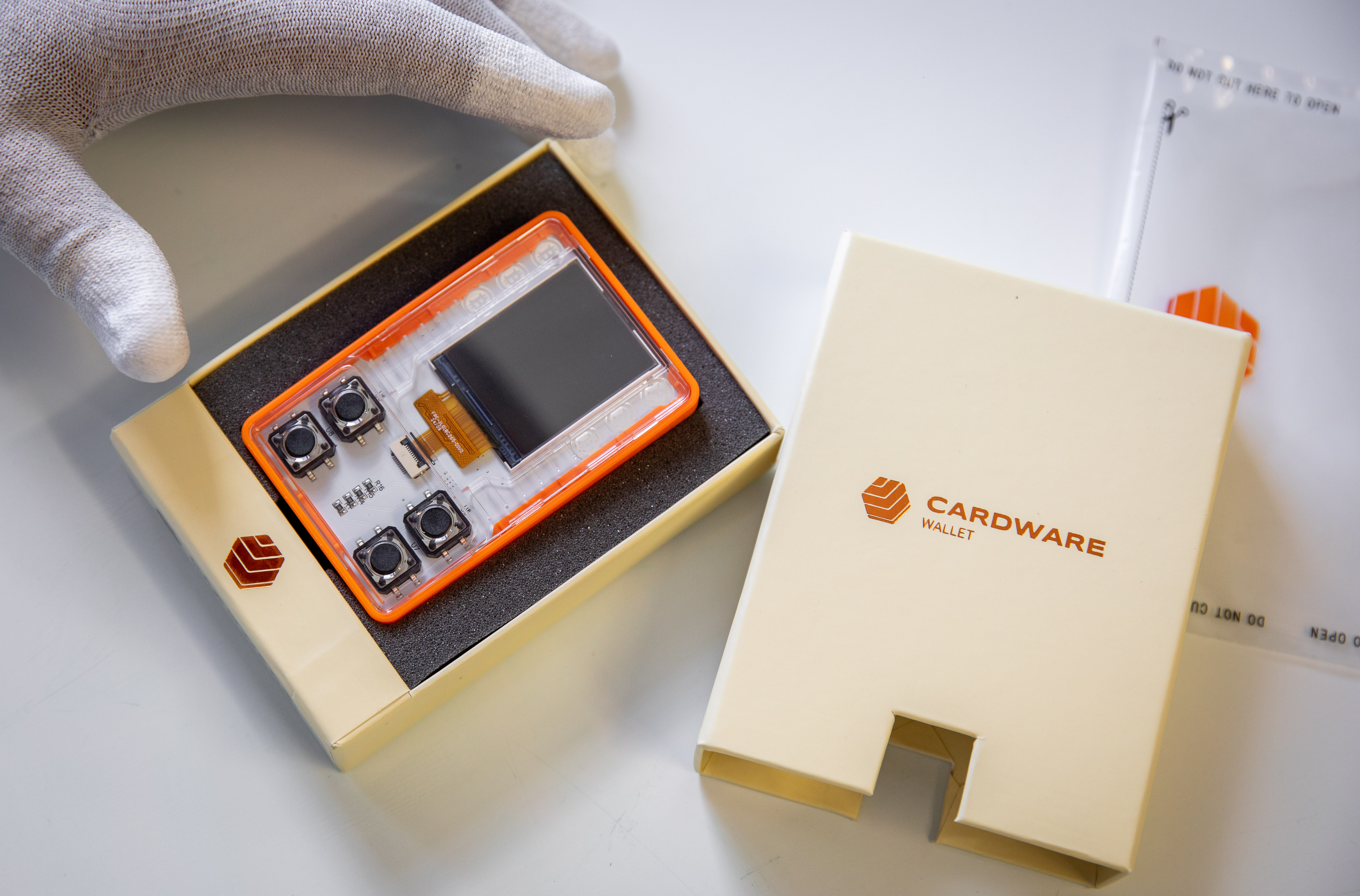
Cardware Wallet is a 100% air-gapped & offline hardware wallet designed to provide secure and affordable solutions for managing digital assets. Powered via USB-C with only power and ground connections active—visibly verified through its transparent circuit board—the device ensures that no data connections are possible. This design keeps private keys completely isolated from the internet and eliminates risks associated with data transmission, offering a robust security solution for cryptocurrency holders.

## **Why Cardware Wallet is Important**

Cardware Wallet addresses the modern demand for verifiable security in digital asset management by operating entirely offline, ensuring that private keys never connect to external networks. Its USB-C port is limited to power and ground only—no data lines—and this transparent design lets users confirm there are no hidden connections. An EAL6+ certified secure element chip, Web Wallet (Watch-Only) accessible, and hardware-level read/write protection combine to guard against physical tampering, unauthorised access, and firmware-based exploits.

Beyond its robust security, Cardware is also designed for practicality: it integrates seamlessly with web-based platforms, offering an NPM package and watch-only wallet features that simplify usage and development. This fusion of powerful security and straightforward web compatibility means users can enjoy convenient monitoring and transaction management without compromising on safety. Finally, Cardware’s “Don’t Trust, Verify” philosophy is embodied in its transparent casing, allowing anyone to visually inspect internal components and gain genuine confidence in the device’s integrity. Together, these features make Cardware Wallet an essential solution for anyone looking to secure their digital assets against modern threats while maintaining user-friendly functionality.

## **Features and Benefits**

1. **100% Air-Gapped and Offline Operation**

*Feature*: Operates without internet, Bluetooth, or Wi-Fi connectivity.

*Benefit*: Prevents exposure to online threats and remote hacking attempts, keeping private keys secure.

2. **USB-C Powered with Transparent Design**

*Feature*: Powered via USB-C with only power and ground connections; all data lines are disconnected and visibly so.&#x20;

*Benefit*: Users can verify that no data can be transmitted through the USB-C connection, eliminating risks associated with malicious cables or data transfer.

3. **High Entropy Key Generation**

*Feature:* Cardware Wallet uses hashed video streams or repeated dice rolls (D20 or D6) to generate highly unpredictable private keys. Each pixel from the video feed or each dice roll outcome is processed by a cryptographic hash function, ensuring a vast and truly random pool of entropy.

*Benefit:* By capturing real-world randomness, the private keys become practically impossible to predict or replicate. This robust entropy source sharply reduces the risk of brute-force attacks and guarantees that your keys remain uniquely secure.

4. **Secure Element Chip**

*Feature*: Utilises an EAL6+ certified secure element chip for key storage.

*Benefit*: Provides a tamper-resistant environment for cryptographic operations, protecting against advanced physical and logical attacks.

5. **Read/Write Protection**

*Feature*: Microchip include read/write protection mechanisms.

*Benefit*: Prevents unauthorised access or modification of the device's firmware and sensitive data, maintaining data integrity.

6. **Web Wallet Integration**

*Feature*: Integrates with web-based platforms through QR codes and our NPM Package, providing easy and accessible functionality for any developers.&#x20;

*Benefit*: Allows Web2 and Web3 based businesses to integrate self custody & hardware wallet solutions using NPM packages with little integration.&#x20;

7. **Advanced Security Features**

*Feature*: Supports multisignature wallets, hierarchical deterministic (HD) wallets, and secure transaction signing via QR codes.

*Benefit*: Enhances security and flexibility in managing digital assets, allowing for distributed signing authority and organised key management.

***

By focusing on offline operation, transparent hardware design, and robust security protocols, Cardware Wallet offers a secure and user-friendly solution for managing digital assets, addressing the critical need for trustworthy hardware wallets in the cryptocurrency space.

***

## For Individual and Business Users

Cardware Wallet serves both individual users and crypto-based companies, communities, and exchanges. For individual users, we offer secure and affordable hardware wallets. For businesses, our B2B solutions allow the creation of branded hardware wallets that integrate directly with existing web platforms, providing clients with self-custody solutions.

***

## Transparency

We are continuously developing new products and services, including later versions of the Cardware Wallet device and a BTC Payment Ecosystem. Transparency is a core value of our flagship product, which features a fully transparent design and open-source materials. Our web apps, accessible across any device with a browser, provide seamless access without requiring downloads or updates.

> ### Welcome to Cardware Wallet, where affordability, high quality, and simplicity converge to provide you with the best in digital asset security.


# Shop

<figure><img src="/files/30ykg3Fwi6ZucdDISKw1" alt=""><figcaption></figcaption></figure>


# Cardware (BTC)

## Cardware (BTC)

<figure><img src="/files/FwnqGAaXjWGbqeMbsiN5" alt=""><figcaption></figcaption></figure>

### **Overview**

The Cardware BTC is a Bitcoin Only hardware wallet specifically designed for Bitcoin maxis seeking a secure and offline solution for managing their digital assets. The device is powered via USB-C with only power and ground connections active—all data lines are disconnected and visibly shown on the circuit board through our transparent casing. This design ensures that private keys remain isolated from the internet and eliminates risks associated with data transmission through cables. The wallet aligns with the stringent security standards valued by Bitcoin maximalists, providing a robust and verifiable solution for secure Bitcoin storage.

### **Device Description:**

Cardware (BTC) is an affordable and secure hardware wallet that offers a truly air-gapped and offline solution for managing your Bitcoin ($BTC) assets. Powered via USB-C with no data rails active—only the power and ground connections are utilised—the device ensures that no data can be transmitted through the USB-C port, maintaining a secure and isolated environment. Utilising Cardware's QR code connection method, you can pair the device in under two seconds and interact with your assets instantly via our Web App, all while ensuring that your private keys are never exposed to the internet. The wallet generates high-entropy private keys through Video Streaming or Dice Rolls upon setup, enhancing the security and uniqueness of your keys. With the absence of data connections (purely power), the device provides easy portability and quick access without the risks associated with external connections, unauthorised code modifications, or malicious actors. Designed for individual or institutional users, Cardware Wallet BTC seamlessly integrates with our watch-only Web Based wallet and is accessible from any device with a browser, offering secure and convenient BTC management. With a strong focus on Web Integration, Cardware Wallet's B2B arm allows for simple and easy integration via NPM packages.&#x20;

### **Device Specifications:**&#x20;

| <ul><li>Size</li></ul>                   | 86 x 54 x 11 mm                                                                              |
| ---------------------------------------- | -------------------------------------------------------------------------------------------- |
| <ul><li>Weight: 60g</li></ul>            | 60g                                                                                          |
| <ul><li>Price</li></ul>                  | $77 *(excl VAT & shipping)*                                                                  |
| <ul><li>Power Source</li></ul>           | USB-C                                                                                        |
| <ul><li>Assets Supported </li></ul>      | BTC Only                                                                                     |
| <ul><li>Private Key Generation</li></ul> | High entropy private keys generated through; Video Streaming, D20 Dice Rolls, D6 Dice Rolls. |

### **What's in the Box**

* Cardware Wallet Device: The air-gapped, offline hardware wallet
* Get Started Guide: Quick instructions to help you set up and use your device
* Seed Phrase Paper: For securely writing down your seed phrase
* QR Code Paper: Links to a comprehensive online guide for detailed instructions and support
* Steel Seed Phrase Sheet: A durable, complementary gift for securely backing up your seed phrase
* D20 Dice: Used for private key generation upon setup
* USB-C Cable: Used for power only.&#x20;

The Cardware Wallet (BTC) combines cutting-edge security features with the convenience of an easy-to-use design. Ideal for both novice and experienced cryptocurrency users, it provides a secure solution for managing your digital assets.

<br>


# Cardware (BTC/EVM)

## More Info Coming Soon..<br>


# Top Up Warranty

## Cardware Wallet Top Up Warranty

To ensure your peace of mind and continued protection of your digital assets, Cardware Wallet offers a comprehensive 1 year (12 month) warranty on the device.&#x20;

Additionally, Cardware offers "Top Up" warranties. This warranty provides an affordable option to maintain your device's functionality over the years without the need to purchase a new product.

### What is the Top Up Warranty?

The Top Up Warranty is an extended service plan that allows you to pay an additional fee for extended coverage of your Cardware Wallet device. This Top Up warranty is available in two options:

*Base Year Already Included*&#x20;

1. One-Year Top Up: Coverage for two years.
2. Two-Year Top Up : Coverage for three years.

### Benefits of the Top Up Warranty:

* Annual Replacement: Receive a replacement device if the device has malfunctioned during the Warranty period, ensuring you always have a fully functional hardware wallet.
* Cost-Effective: The Top Up Warranty costs significantly less than purchasing a new device, offering substantial savings over time.
* Continued Security: Ensure the continuous security of your digital assets with a reliable and up-to-date Cardware Wallet.

### How to Purchase:

* Add to Cart: When purchasing your Cardware Wallet, simply select the Top Up Warranty option that best suits your needs.
* Secure Payment: Complete your payment along with your device purchase.

### Terms and Conditions:

For more information on the Warranty terms & conditions, please visit our Compliance Pack:

{% content-ref url="/pages/GOt5tqex3RA926Ue0u5M" %}
[Warranty](/cardware-wallet-documentation/compliance-pack/warranty)
{% endcontent-ref %}

With the Cardware Wallet Top Up Warranty, you can rest assured that your investment is protected, and your digital assets remain secure.<br>


# Getting Started

Cardware BTC Device Guides

<figure><img src="/files/EDfMz4o3JMphq8oSKiAk" alt=""><figcaption></figcaption></figure>

## Text Guides:&#x20;

{% content-ref url="/pages/QmWgMhFgofReDQ9qVC7X" %}
[Text Guides](/cardware-wallet-documentation/getting-started/text-guides)
{% endcontent-ref %}

## Video Guides:

{% content-ref url="/pages/VYtC8IZNee1MsEMiOVtU" %}
[Video Guides](/cardware-wallet-documentation/getting-started/video-guides)
{% endcontent-ref %}

***


# Text Guides

## Getting Started

#### **Step 1) Open Tamperproof Bag and Unbox your Cardware Wallet**

* Ensure the tamper-proof seal has not been tampered with
* Open and remove the Cardware Box from the tamper-proof packaging
* Inside the Cardware Box, you will find your&#x20;
  * Cardware Device,&#x20;
  * USB-C Cable,&#x20;
  * D20 dice,&#x20;
  * Steel Seed Phrase Backup,
  * Paper Seed Phrase Backup, and
  * Get Started guides.&#x20;

{% hint style="danger" %}
**Note:** Do not use the device if the tamperproof packaging is opened and displays the word "VOID" over the red section. Please ensure to contact support and do not use the device.&#x20;
{% endhint %}

<figure><img src="/files/7k1VFuPMP5UcAE8NsyT6" alt="" width="563"><figcaption></figcaption></figure>

#### Step 2) **Power On Device**&#x20;

* Remove the foam within the box
* Take the Cable, D20 dice & Seed Phrase backups out of the box
* Plug the USB-C cable into the device and plug the corresponding end into a power source; phone, laptop or even an external power bank.

{% hint style="success" %}
Note: The USB cable provided is purely for power; no data transmission occurs from this point.
{% endhint %}

<figure><img src="/files/i5Cy8lc7cKCrtYLsCcCX" alt="" width="563"><figcaption></figcaption></figure>

#### Step 3) Device Navigation:

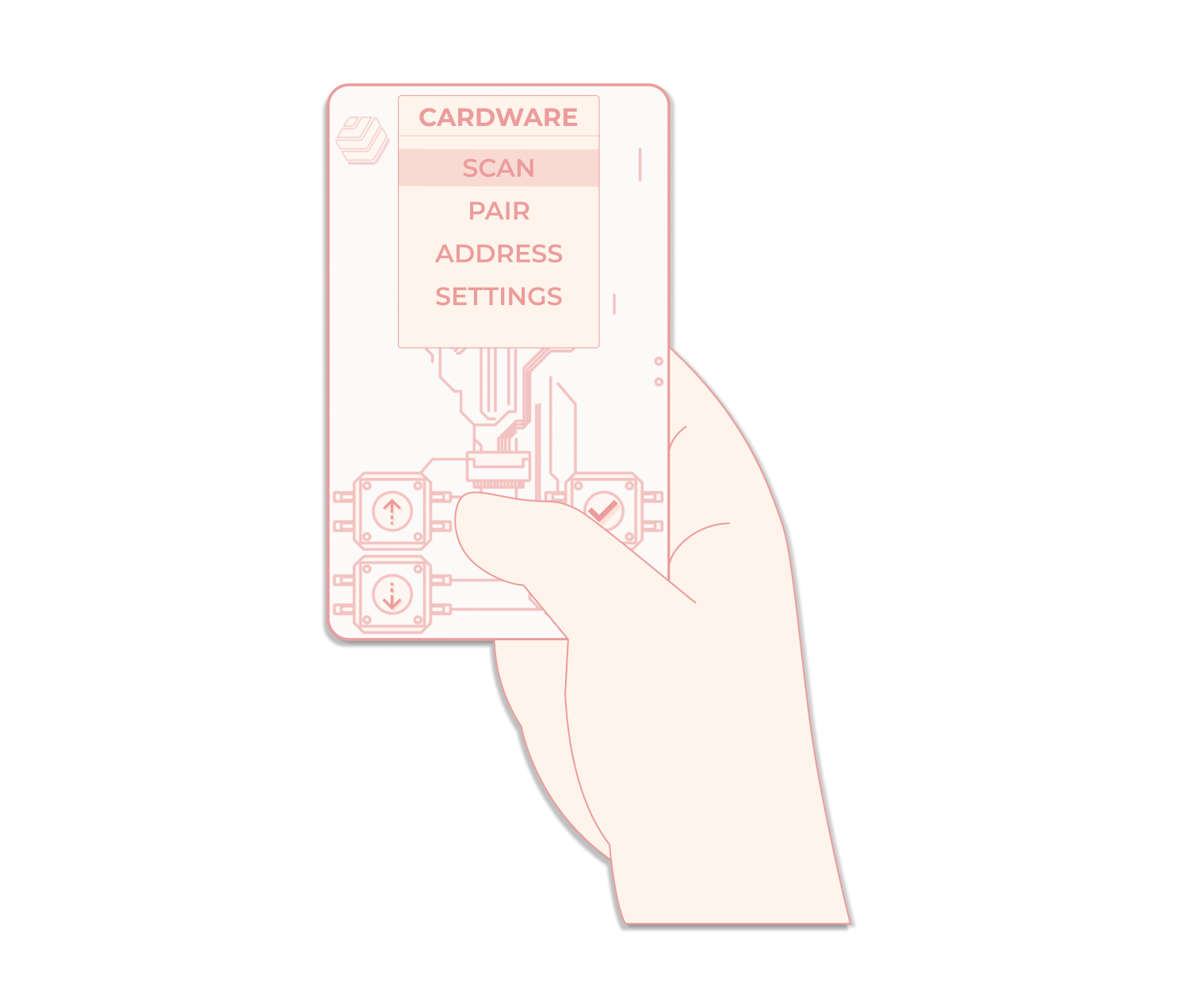
The Cardware interface includes a screen, a camera, and four buttons: Up, Down, Accept, and Back.

* Top Left = Up
* Bottom Left = Down
* Top Right = Accept
* Bottom Right = Back/Reject

<figure><img src="/files/JuCzaCQrmvIvbFmMb7J6" alt="" width="563"><figcaption></figcaption></figure>

#### Step 4) Wallet Setup&#x20;

* After plugging in the device, you will see the Cardware Loading Screen
* The device will prompt you to choose your form of user-generated entropy for creating your private key. You have three options:&#x20;
  * **Hashed Video Streaming**
  * **D20 Dice Rolls**
  * **D60 Dice Rolls**&#x20;
* The Cardware Device also has another option for **import** if you would like to import an existing seed phrase.

<figure><img src="/files/ODDoiMRMIX2cW4lpGtdL" alt="" width="563"><figcaption></figcaption></figure>

#### Step 5)  Creating a NEW Wallet&#x20;

You will have the choice to create your private key via 3 options:&#x20;

1. **Hashed Video Stream:** Click on the Video option and move your camera around your environment. This process will hash each frame of a video stream and then hash the result of the many frame hashes. When hashing a frame, every pixel is used. This allows you to generate your private key based on your physical surroundings.

{% hint style="info" %}
&#x20;Note: Avoid filming uniform, featureless surfaces (eg. a white wall).
{% endhint %}

2. **D20 Dice Rolls:** Click on the D20 option. Using the provided D20 dice, roll the dice and input the number into the device (using the up, down and accept buttons). With the D20 dice, you will need to input your dice rolls 64 times to generate your private key.<br>
3. **D6 Dice Rolls:** In a similar procedure to the above, roll a D6 dice and input each number into the Cardware device. You will need to input your dice rolls 100 times to generate your private key.&#x20;

{% hint style="info" %}
Note: Ensure to enter your exact dice rolls each time to securely generate your unique key.&#x20;
{% endhint %}

<figure><img src="/files/uvdsbvlnVVif92MWeAuF" alt="" width="563"><figcaption></figcaption></figure>

**OR**&#x20;

<figure><img src="/files/FHRq2mxYnU0nawLPlVgu" alt="" width="563"><figcaption></figcaption></figure>

#### Step 6) Seed Phrase Backup

* Seed Phrase Backup: After generating your private key, the device will display your 24-word seed phrase.
* Write this down securely on the provided Seed Phrase Backup Paper.
* Alternatively, use the provided steel seed plate to engrave your 24-word seed phrase for long-term durability.

{% hint style="danger" %}
Note: Make sure to store this seed phrase in a private location. Preferably a hardcopy to prevent any technological hacks. NEVER share this phrase with anyone.
{% endhint %}

<figure><img src="/files/lRcEgle6xl6z21y9KsQR" alt="" width="563"><figcaption></figcaption></figure>

#### Step 7) Seed Phrase Setup

* The device will then prompt you to re-enter the seed phrase
* Using the Up, Down, Accept, and Back buttons, navigate through the word list and enter all 24 words in the correct order that the seed phrase was displayed in.&#x20;

<figure><img src="/files/iWGaMn3ouzArQKFQYumg" alt="" width="563"><figcaption></figcaption></figure>

#### Step 8) Set & Confirm Pin

After re-entering the seed phrase, you’ll be prompted to set and confirm a PIN:

* Once your seed phrase is securely backed up, the device will prompt you to set a PIN.
* Use the left buttons (up and down) to select a number and the top right button (accept) to move to the next digit. You can use the bottom right button (back) to go back to your previous number if you would like to change it.&#x20;
* The PIN must be a minimum of 5 digits, and a maximum of 8 digits.
* You will be prompted to re-enter your PIN to confirm it.

{% hint style="info" %}
You must enter this PIN each time you power on the device and when making a transaction. You can disable “PIN on startup” in the device settings, but “PIN on transaction” is always required.
{% endhint %}

{% hint style="danger" %}
You have 5 attempts to enter your PIN correctly when prompted. Entering it incorrectly 5 times will erase the device. Consider saving your PIN in a secure hardcopy format as well.
{% endhint %}

<figure><img src="/files/qfLeGMwzGKzWqdlNUw4M" alt="" width="563"><figcaption></figcaption></figure>

#### Step 9) Congratulations

* You have successfully generated a private key on an offline, air-gapped device. You can now use it to securely store and transact with your digital assets. After a complete setup, you will see the home page of the device:

<figure><img src="/files/Fv00gpMVoNTcKLMt31HF" alt="" width="563"><figcaption></figcaption></figure>

***

## Pairing Device&#x20;

Once your device has been setup correctly, follow these steps to pair your device to the Cardware Web App (ie. Connect Wallet).

#### Step 1)  Click on the Pair button.

* Plug in your Cardware device. This will display the Cardware loading screen, and eventually the home screen.
* Using the down button, navigate to the "Pair" option and click on this button.
* Clicking on this button will display a range of flashing QR codes. You will need to scan these QR codes via the Web App.&#x20;

<figure><img src="/files/oXy5sgUeZfwI8xb8VCFk" alt="" width="563"><figcaption></figcaption></figure>

#### Step 2)  Visit Web App & Scan QR Codes

On your mobile device or desktop, visit the [Cardware Web Wallet](https://wallet.cardwarewallet.com/)

* Click on the "Pair Device" button on the Web App.
* Using your mobile, laptop or destop camera, scan the flashing QR codes.
* This will pair your device and show you the Home Screen of the Web App.

<figure><img src="/files/AOIxiZnghyeJaIJe4oDK" alt="" width="563"><figcaption></figcaption></figure>

**OR**

<figure><img src="/files/rOFwAc6Eu32bZCZqYTOW" alt="" width="563"><figcaption></figcaption></figure>

***

## Importing Wallet&#x20;

If you have an existing private key that you would like to import into the device, you can import the private key upon setup.&#x20;

#### Step 1) Import Wallet:

* Upon device setup, you will have the option to create a wallet or import a wallet.&#x20;
* Navigate down to the "Import" option and click on this button.

<figure><img src="/files/rJrB9epE12LYlPg6gTaV" alt="" width="563"><figcaption></figcaption></figure>

#### Step 2) Enter Seed Phrase&#x20;

* The device will prompt you to enter the first letter.
* Using the navigation buttons (up and down), navigate through the alphabet to select your first letter of your first word.
* You will then have to do this for the second letter of your first word.
* The device will then display word options based off your inputs (according to the BIP39 word list).
* Select your fist word.

You will then have to complete this same process for the remaining 23 words of your seed phrase.

<figure><img src="/files/BkyDHgYz1X8Aa5wqYxQW" alt="" width="563"><figcaption></figcaption></figure>

***

## Transacting (Sending)

#### Step 1: Visit the Web App

Navigate to the [Cardware Web App](https://wallet.cardwarewallet.com/)

* Tap the “Send” button
* Enter the recipient’s BTC address
* Specify the amount of BTC
* Select the desired transaction fee (low, medium, or high)
* Press “Send” to initiate the transaction

<figure><img src="/files/RQoKTr4Wfxd2PQMKRju2" alt="" width="563"><figcaption></figcaption></figure>

#### Step 2: Review the PSBTs

The Web App will display a range of Partially Signed Bitcoin Transactions (PSBTs) as QR Codes.

<figure><img src="/files/V6ibXX2DfCSCaqGah65n" alt="" width="563"><figcaption></figcaption></figure>

#### Step 3: Scan PSBT's

On your Cardware device, tap “Scan” and aim the camera at the QR codes.

* After scanning the first QR code, tap “Next” to view the subsequent codes.
* If you miss a code, tap “Prev” to go back.

{% hint style="info" %}
Note: If the device does not scan the QR code, try rotating the device 90 degrees.
{% endhint %}

<figure><img src="/files/62LS540k6FInqMOsWp7L" alt="" width="563"><figcaption></figcaption></figure>

#### Step 4: Confirm Transaction on Your Device

After scanning all of the QR codes, review the recipient’s address and amount on your Cardware device.

* If the details are correct, press the "Next" button.

<figure><img src="/files/CP7mVAjUxFXoH9vU5x5N" alt="" width="563"><figcaption></figcaption></figure>

#### Step 5: Confirm Fees on Your Device

Review the transaction fees on your Cardware device.

* If the details are correct, press the "Confirm" button.

<figure><img src="/files/mCVuefugz39Trq3hWQEl" alt="" width="563"><figcaption></figcaption></figure>

#### Step 6: Signing Transaction

* After confirming the details, your device will sign the transaction offline.

<figure><img src="/files/nHvKd4WdMb8ruihJMeqf" alt="" width="563"><figcaption></figcaption></figure>

#### Step 7: Transaction Ready for Broadcast

After you have signed the transaction offline:

* The Cardware device will then display the signed transactions as QR Codes.

<figure><img src="/files/hI15MtrqySWgiIjgmcFT" alt="" width="563"><figcaption></figcaption></figure>

#### Step 8: Broadcast Transaction

Using the Cardware Web App:

* Click on broadcast on the Web App and scan the QR codes on the Cardware device with your mobile or desktop camera.&#x20;
* After you have scanned all the necessary QR codes, the transaction will then be broadcasted to the Bitcoin network and you will see a "Transaction Complete" popup.

<figure><img src="/files/fZ6Z4I8qWEsP7FfrMhny" alt="" width="563"><figcaption></figcaption></figure>


# Video Guides

## Video Guides

1. **Unboxing Cardware Wallet**

{% embed url="<https://www.youtube.com/watch?v=VBAuQJSWOsw>" %}

2. **Generating Entropy (Hashed Video Stream)**

{% embed url="<https://www.youtube.com/watch?v=OH5eTBerBBc>" %}

3. **Generating Entropy (D20 Dice)**

{% embed url="<https://www.youtube.com/watch?v=IVTedW3qlHg>" %}

4. **Inputting Seed Phrase After Entropy Generation**&#x20;

{% embed url="<https://www.youtube.com/watch?v=YGSegcVaoMg>" %}

5. **Restoring/Importing Seed Phrase**&#x20;

{% embed url="<https://www.youtube.com/watch?v=qMxdRqGduHQ>" %}

6. **Device Navigation**

{% embed url="<https://www.youtube.com/watch?v=ZQI1zbwh7cM>" %}

7. **Sending BTC (Air-Gapped Transaction)**

{% embed url="<https://www.youtube.com/watch?v=ZpyfffAOCTU>" %}

8. **Pairing With Cardware (Mobile)**

{% embed url="<https://www.youtube.com/watch?v=5j8zAI0D2UY>" %}

9. **Erasing/Wiping Device**&#x20;

{% embed url="<https://www.youtube.com/watch?v=JYwMWRw99fI>" %}


# Hardware Wallet Comparison

## Hardware Wallet Comparison

{% code fullWidth="false" %}

```markup
A comparison of current hardware wallets & their features.

| Device                | Price (USD)     | 100% Air-Gapped     | Transfer Data via Cable  | 100% Offline     | Connection Method      | Secure Chip Certification     | Lightning Support      | Open Sourced     | Transparent Product    | Altcoin Support  | Multisig Support (PSBTs) | Steel Seed Phrase     | Microcontroller Read/Write Protection** |
| --------------------- | --------------- | ------------------- | ------------------------ | ---------------- | ---------------------- | ----------------------------- | ---------------------- | ---------------  | ---------------------- | ---------------- | ------------------------ | --------------------- | -------------------------------------   |
| Cardware Wallet 1.0   | $77.00          | Yes                 | No                       | Yes              | QR Code Scanning       | CC EAL6+                      | Yes                    | Yes              | Yes                    | Yes              | Yes                      | Yes                   | Yes                                     |
| Coldcard MK4          | $157.94         | No                  | Yes                      | No               | USB-C                  | No Certification (2 Chips)    | No                     | No               | Semi-Transparent       | No               | Yes                      | No                    | No                                      |
| Coldcard Q            | $219.99         | No                  | Yes                      | No               | USB-C                  | No Certification (2 Chips)    | No                     | No               | Semi-Transparent       | No               | Yes                      | No                    | No                                      |
| Ellipal Titan 2.0     | $169.00         | No                  | Yes                      | No               | QR Code Scanning       | CC EAL5+                      | No                     | No               | No                     | Yes              | No                       | Separate Product      | No                                      |
| Keystone 3 Pro        | $149.00         | No                  | Yes                      | No               | QR Code Scanning       | PCI                           | Yes (Open Node)        | Yes              | No                     | Yes              | Yes                      | Separate Product      | No                                      |
| Ledger Nano S         | $79.00          | No                  | Yes                      | No               | USB-C                  | CC EAL5+                      | No                     | No               | No                     | Yes              | Yes                      | Separate Product      | No                                      |
| Ledger Nano X         | $149.00         | No                  | Yes                      | No               | USB-C/Bluetooth        | CC EAL5+                      | No                     | No               | No                     | Yes              | Yes                      | Separate Product      | No                                      |
| Ledger Stax           | $399.00         | No                  | Yes                      | No               | USB-C                  | CC EAL6+                      | No                     | No               | No                     | Yes              | Yes                      | Separate Product      | No                                      |
| Safepal S1 Pro        | $89.99          | No                  | Yes                      | No               | QR Code Scanning       | CC EAL5+                      | No                     | No               | No                     | Yes              | No                       | Separate Product      | No                                      |
| SeedSigner            | $80.00          | No                  | Yes                      | No               | QR Code Scanning       | No Secure Elements            | Yes                    | Yes              | No                     | No               | Yes                      | No                    | No                                      |
| Trezor Model          | $149.00         | No                  | Yes                      | No               | USB-C                  | No Secure Elements            | Yes (Confirmo.net)     | Yes              | No                     | Yes              | Yes                      | No                    | No                                      |

Disclaimer: The data above is sourced from publicly available information and may be subject to change._

```

{% endcode %}

### Sources:

* <https://thebitcoinhole.com/hardware-wallets><br>
* <https://coldcard.com/docs/coldcard-mk4/><br>
* <https://www.maximintegrated.com/en/products/security/ds28c36b.html><br>
* <https://www.microchip.com/en-us/product/ATECC608B>

<br>


# Features

<figure><img src="/files/olIvvhhv68mH6oyvO2W9" alt=""><figcaption></figcaption></figure>


# Security Features

## Security Features:

### **EAL6+ Certified Secure Element Chip**

*Feature*: The Cardware Wallet integrates an EAL6+ certified secure element chip for cryptographic key generation and secure storage. This certification represents one of the highest levels of security assurance for hardware components, indicating compliance with stringent evaluation criteria and resistance to sophisticated attack methods.

*Benefit*: The secure element provides a tamper-resistant environment that protects cryptographic operations against advanced physical and logical attacks. By isolating private keys within this dedicated hardware component (while also being encrypted), the wallet significantly reduces the risk of key extraction or unauthorised access. This ensures that sensitive cryptographic material remains protected throughout the device's lifecycle, enhancing overall security for digital asset management.

***

### **High Entropy Key Generation**

*Feature:* Our key-generation process employs three distinct methods—hashed video streams, D20 dice rolls, and D6 dice rolls—to maximize entropy for secure private keys. With the video stream approach, every video frame is processed through a cryptographic hash function (e.g., SHA-256), then the hashed outputs of all frames are iteratively combined into a single final hash which is used for entropy. This ensures that minuscule changes in lighting, color, and movement introduce vast unpredictability. In the dice-based methods, each roll (64 times for the 20-sided die, 100 times for the 6-sided die) is manually entered into the device allowing for top tier sourced entropy. By allowing randomness both from real-world visual data and physical dice rolls, our system guarantees high-entropy, collision-resistant private keys that are infeasible to replicate or brute force.

*Benefit:* By harvesting genuine, unpredictable data from physical processes—rapidly changing environmental video frames or the inherently random outcomes of dice rolls—your private keys gain the highest possible degree of cryptographic strength. This significantly reduces the likelihood of successful attacks, as no external party can feasibly recreate the exact sequence of pixel data or dice results, ensuring that your keys remain uniquely secure and resistant to compromise.

{% hint style="danger" %}
Note: When generating your private key through the Video Stream option, ensure to move your camera around and avoid filming uniform, featureless surfaces.\
\
When generating your private key through the Dice Roll option, ensure to input your exact rolls.&#x20;
{% endhint %}

***

### **100% Air-Gapped and Offline Operation**

*Feature*: Designed without any form of network connectivity, the Cardware Wallet lacks internet access, Bluetooth, Wi-Fi, or any wireless communication modules.

*Benefit*: Operating entirely offline, the device eliminates exposure to remote attacks that could exploit network connections. This air-gapped approach ensures that private keys and transaction data remain confined within the secure environment of the wallet, preventing unauthorised access or interception by external entities. It provides an additional layer of defence by removing potential attack vectors associated with connectivity, thereby enhancing the overall security posture.

***

### **Read/Write Protection**

*Feature*: The secure element chip and STM32 microcontroller incorporate read-out protection and write protection mechanisms.

*Benefit*: These security features prevent unauthorised access to, or modification of, the device's memory and firmware. Read-out protection ensures that sensitive data, including private keys and cryptographic algorithms, cannot be extracted from the device, safeguarding against physical attacks. Write protection preserves the integrity of the firmware by blocking unauthorised changes, thereby preventing potential tampering or the introduction of malicious software. Together, these mechanisms uphold the confidentiality and integrity of critical system components.

***

### **No Data Connections via USB-C**

*Feature*: The USB-C port is configured exclusively for power delivery, with only the power and ground connections active. All data lines are physically disconnected, a design aspect that is visibly apparent on the transparent circuit board.

*Benefit*: By eliminating data transmission capabilities through the USB-C port, the device mitigates risks associated with compromised cables or USB-based attacks, such as data theft or malware injection. Users can visually verify the absence of active data lines, reinforcing trust in the device's physical security measures. This approach ensures that power can be supplied safely without introducing potential vulnerabilities associated with data connectivity.

***

### 100% Offline Signing

*Feature:* Cardware Wallet performs transaction signing in an isolated, air-gapped environment. The USB-C port is used solely for power, as it lacks data lines, ensuring no data transmission occurs during the signing process.

*Benefit:* This design minimises the potential attack surface by preventing any external data connectivity during critical signing operations, thereby protecting the integrity of private keys and transaction data.

***

### **Key Features Summary**

* **EAL6+ Certified Secure Element**: Provides high-assurance hardware security for cryptographic key management.
* **High Entropy Key Generation**: Generates unique and unpredictable private keys through random pixel sampling.
* **Air-Gapped and Offline Operation**: Eliminates exposure to network-based threats by operating without connectivity.
* **Read/Write Protection**: Protects memory and firmware against unauthorized access or alterations.
* **USB-C Powered with Transparent Verification**: Ensures safe power delivery without data transmission, visibly verifiable by users.
* **Secure Transaction Signing via QR Codes**: Allows secure transaction processing while keeping private keys isolated.

These features collectively establish a robust security framework for managing and safeguarding digital assets, ensuring that private keys and transaction data are protected against a wide spectrum of threats.


# Advanced Features

## Advanced Security Features

1. Multi-Signature (Multisig) Support

Cardware Wallet includes multisig capabilities that require multiple private keys to authorize a transaction. This feature distributes signing authority across multiple parties or devices, lowering the risk of unauthorized access. Multisig is especially beneficial for institutional investors, collaborative funds, or joint account setups by providing enhanced control and security.

2. Hierarchical Deterministic (HD) Wallets

The wallet supports BIP-32 compliant HD functionality, allowing users to generate an unlimited number of private keys from a single master seed. This tree-like key derivation not only streamlines wallet management but also enhances privacy by enabling a new address for each transaction without exposing the master key

3. Broad Cryptocurrency Compatibility

Cardware Wallet is available in two product versions:

* **BTC-Only Version:** Exclusively supports Bitcoin (BTC).
* **BTC and EVM Version:** Supports Bitcoin alongside Ethereum (ETH & ERC-20 tokens) and any EVM-compatible blockchain.

Both versions are optimized for secure, efficient transaction processing, ensuring reliable performance across supported networks.

4. QR Code-Based Transactions

Transactions are securely managed via a QR code system. The Web Wallet generates a partially signed bitcoin transaction (PSBT), which is then scanned by the Cardware device to sign the transaction and display the signed transaction as QR codes. The Web Wallet then broadcasts these signed transactions to the network. This air-gapped approach keeps private keys isolated from network exposure, significantly reducing risks from malware or remote attacks.

5. Backup and Recovery Options

The wallet implements robust backup and recovery features centered on a 24-word mnemonic seed phrase. This seed phrase is the root for all derived keys and is essential for restoring the wallet if needed. For added durability, a steel seed phrase sheet is provided to protect against environmental damage (fire, water, etc.). Additionally, the Cardware wallet supports restoring your private key upon setup.


# Community & Updates

## Community

* [Twitter](https://twitter.com/CardwareWallet)
* [Telegram](https://t.me/CardwareWallet)
* [Discord](https://discord.gg/dgDXR85CXB)
* [Reddit](https://www.reddit.com/r/CardwareWallet/)
* [Facebook](https://www.facebook.com/profile.php?id=61563391794698)

***


# Cardware B2B

<figure><img src="/files/4PVucegIVKzCfJijUm7g" alt=""><figcaption></figcaption></figure>

## **Cardware Wallet B2B Solutions**

Cardware Wallet provides specialised B2B solutions for self custody for financial institutions, cryptocurrency companies, communities, exchanges, and other organisations seeking to enhance their digital asset security offerings. By supplying secure, branded hardware wallets that integrate seamlessly with your existing web platforms, we enable you to offer your users a self-custodial environment for managing digital assets while maintaining interaction with your services.

### **Key Advantages**

* **Enhanced Security**

  Cardware Wallet devices operate entirely offline, utilising an air-gapped design to ensure that private keys remain isolated from network threats. Powered via USB-C with only power and ground connections active—all data lines are disconnected and visibly so—the devices eliminate risks associated with data transmission through cables. The transparent hardware design allows users to verify that no data connections are present, reinforcing trust in the security of the device.
* **Little Integration**

  Our hardware wallets are designed to integrate directly with your web platforms using QR code communication methods. This allows for secure transaction signing and verification without exposing private keys to the internet. Users can monitor their assets through a watch-only interface on your platform (via our Open Sourced NPM Packages), while all transaction approvals require the physical hardware device, maintaining the highest level of security.
* **Custom Branding**

  Cardware Wallets can be customised to reflect your organisation's branding, including logos, colour schemes, and packaging. This enables you to offer a hardware wallet that aligns with your brand identity, enhancing user recognition and loyalty while providing a secure product that meets your clients' needs.

***

### **Key Features**

* **Air-Gapped and Offline Operation**

  Devices are designed without any form of network connectivity, including internet, Bluetooth, or Wi-Fi, ensuring that private keys and transaction data remain secure and isolated from remote attacks.
* **USB-C Powered with Transparent Verification**

  The USB-C port is configured exclusively for power delivery, with data lines physically disconnected and visible through the transparent casing. This design eliminates risks associated with data connections and allows users to verify the absence of active data lines.
* **Secure Transaction Signing via QR Codes**

  Transactions are signed within the secure element of the hardware wallet, using QR codes for data transfer. This process ensures that private keys remain within the secure environment and are never exposed during transaction signing.
* **Compliance with Industry Standards**

  The hardware wallets support standard protocols and are compatible with multiple cryptocurrencies, including Bitcoin (BTC), Ethereum (ETH), and other EVM-based assets, allowing for versatile asset management.

***

### **Benefits for Your Organisation**

**Strengthen Security Offerings**

By integrating Cardware Wallets into your product suite, you significantly enhance the security options available to your users. Our hardware wallets provide an air-gapped, offline solution for digital asset management, addressing the critical need for secure storage and transaction signing. This addition demonstrates your organisation's commitment to protecting user assets against evolving cyber threats.

**Enhance User Trust and Confidence**

Offering a transparent and verifiable hardware wallet fosters greater trust and confidence among your users. The transparent design allows users to verify the absence of data connections and the integrity of the device, reinforcing your organisation's dedication to security and transparency. This commitment can improve user retention and satisfaction by aligning with their expectations for privacy and control over their digital assets.

**Differentiate Your Services in the Market**

Custom-branded hardware wallets enable your organisation to differentiate its services in a competitive market. By providing a unique product that combines robust security features with your brand identity, you create a distinctive value proposition. This differentiation can attract new users and strengthen brand loyalty among existing clients.

**Facilitate User Adoption and Engagement**

Seamless integration with your existing web platforms ensures a smooth user experience, making it easier for users to adopt and utilize the hardware wallets. The intuitive interface and compatibility with standard protocols reduce barriers to entry, encouraging users to engage more deeply with your services. This increased engagement can lead to higher user satisfaction and long-term retention.

**Expand Service Offerings and Revenue Streams**

Offering secure hardware wallets allows you to expand your service offerings, potentially opening new revenue streams through sales or enhanced services. This expansion can contribute to your organisation's growth and adaptability in the rapidly evolving digital asset landscape.

By leveraging these benefits, your organisation can enhance its market position, build stronger relationships with users, and stay ahead in the dynamic field of digital asset management.

***

### **Getting Started**

To explore how Cardware Wallet's B2B solutions can enhance your organisations digital asset security offerings, please contact our team:

* **Email**: <contact@cardwarewallet.com>

Our specialists are available to discuss your requirements and tailor a solution that aligns with your organisation's goals.

***

By partnering with Cardware Wallet, your organisation can offer secure, customised hardware wallets that enhance your service offerings and provide your users with reliable digital asset security. Our focus on robust security features, seamless integration, and custom branding ensures that you can meet the evolving needs of your clients in the digital asset landscape.


# NPM Package

## Cardware BTC NPM Library

{% hint style="success" %}
View On NPM: <https://www.npmjs.com/package/cardware-btc>
{% endhint %}

This is the documentation for the BTC NPM package that communicates with the Cardware device.

The library requires an electrs endpoint to query the bitcoin blockchain.

It allows users to create a Watch-Only Wallet on Web.

All data that is transferred between the web wallet and the Cardware device is done through scanning QR codes.

Users must first pair the web wallet with their Cardware device.

Once paired they are then able to view the BTC address of their Cardware device, see their confirmed and unconfirmed BTC balances and send BTC from their Cardware device.

When sending, the watch only wallet will create an unsigned transaction which will be split up into QR codes. The user will then be prompted to scan these QRcodes with their Cardware device. The user will then confirm the transactions details which will then create a signed transaction which their Cardware device will split up into QR codes. The web wallet then scans these QR codes, decodes them and broadcasts the transaction.

***

## Documentation

### Initialization

#### Code

```javascript
import Wallet from 'cardware-btc'; 
```

***

### New Wallet

This function initializes a wallet object in your web wallet. The zpub is received from the Cardware device after successfully pairing the web wallet and Cardware device. The pairing process involves scanning the **pair** QR codes from the Cardware device, extracting the zpub, then using it in creating the wallet object.

#### Parameters

| Parameter    | Type   | Description                                     | Example                                                                                                             |
| ------------ | ------ | ----------------------------------------------- | ------------------------------------------------------------------------------------------------------------------- |
| zpub         | string | The zpub of the the hardware wallet.            | `"vpub5ZNhc5KKM6hACK6QDuo6UG1749XUeXf9Gbu8rcZQnNDeMJwUPrwzEVKsF7X7EzZe5yqwymfMA1tGJ9qAmjdmGHSkRW7SruCEDz9mgEkwWvN"` |
| esplora\_url | string | The address of the esplora you are using.       | `"https://blockstream.info/api"`                                                                                    |
| network      | string | The network you are using (mainnet or testnet). | `"mainnet"`                                                                                                         |

#### Code

```javascript
var wallet = await new Wallet(zpub, esplora_url, network);
```

#### Output

No outputs.

***

### Sync

This function syncs your web wallet to make sure it has all the correct information to be able to get balances, construct unsigned transactions and broadcast transactions.

#### Parameters

No parameters.

#### Code

```javascript
await wallet.sync();
```

#### Output

The output is a string.

| Result  | Description                                           | Output                                               |
| ------- | ----------------------------------------------------- | ---------------------------------------------------- |
| success | The wallet has synced successfully.                   | `"Sync successful."`                                 |
| error   | There is an issue fetching the fee estimates.         | `"Error: Fee sync error."`                           |
| error   | There is an issue with connecting to the esplora url. | `"Error: Failed to connect to full node (Esplora)."` |
| error   | There is an issue deserializing the transaction.      | `"Error: Failed to deserialize transaction."`        |

***

### Sync to Depth

This function syncs your web wallet with max depth as a parameter to make sure it has all the correct information to be able to get balances, construct unsigned transactions and broadcast transactions.

#### Parameters

| Parameter  | Type   | Description                                      | Example   |
| ---------- | ------ | ------------------------------------------------ | --------- |
| max\_depth | string | The max depth of the addresses you need to sync. | `"m/0/0"` |

#### Code

```javascript
await wallet.sync_to_depth(max_depth);
```

#### Output

The output is a string.

| Result  | Description                                           | Output                                               |
| ------- | ----------------------------------------------------- | ---------------------------------------------------- |
| success | The wallet has synced successfully.                   | `"Sync successful."`                                 |
| error   | There is an issue fetching the fee estimates.         | `"Error: Fee sync error."`                           |
| error   | There is an issue with connecting to the esplora url. | `"Error: Failed to connect to full node (Esplora)."` |
| error   | There is an issue deserializing the transaction.      | `"Error: Failed to deserialize transaction."`        |

***

### Estimate Fees

This function estimates fees for a send transaction which takes a variable called **number of blocks** where the lower the number of blocks, the higher the estimated fee and the faster the transaction will confirm. Users can batch send transactions by populating multiple addresses and multiple amounts however the user must make sure both arrays have the same length.

#### Parameters

| Parameter          | Type           | Description                                                                        | Example                                          |
| ------------------ | -------------- | ---------------------------------------------------------------------------------- | ------------------------------------------------ |
| addresses          | array\[string] | The addresses to send to.                                                          | `["bc1q82d5gkw4xa0dgs55khfx0y4s7ntjwtfxu4h4fg"]` |
| amounts            | array\[int64]  | The send amounts in satoshis.                                                      | `[1480]`                                         |
| number\_of\_blocks | int32          | The number of blocks for fee estimation. The lower the number, the higher the fee. | `3`                                              |

#### Code

```javascript
let result = wallet.estimate_fee(addresses, amounts, number_of_blocks);
```

#### Output

The output is a uint64.

| Result  | Description                                                        | Output |
| ------- | ------------------------------------------------------------------ | ------ |
| success | The fee estimation for a transaction (in satoshis).                | `1480` |
| error   | The addresses array and the amounts array are not the same length. | `0`    |
| error   | There is an issue parsing the network.                             | `1`    |
| error   | There is an invalid recipient address.                             | `2`    |
| error   | There is an issue fetching the fee estimates.                      | `3`    |
| error   | There is insufficient BTC to make this transaction.                | `4`    |
| error   | There are no UTXOs to spend.                                       | `5`    |

***

### Estimate Sweep Fees

This function estimates fees for a max send transaction which takes a variable called **number of blocks** where the lower the number of blocks, the higher the estimated fee and the faster the transaction will confirm. This is called a sweep when a user wants to empty their wallet.

#### Parameters

| Parameter          | Type  | Description                                                                        | Example |
| ------------------ | ----- | ---------------------------------------------------------------------------------- | ------- |
| number\_of\_blocks | int32 | The number of blocks for fee estimation. The lower the number, the higher the fee. | `3`     |

#### Code

```javascript
let result = wallet.estimate_sweep_fee(number_of_blocks);
```

#### Output

The output is a uint64.

| Result  | Description                                         | Output |
| ------- | --------------------------------------------------- | ------ |
| success | The fee estimation for a transaction (in satoshis). | `1480` |
| error   | There is an issue parsing the network.              | `1`    |
| error   | There is an issue fetching the fee estimates.       | `3`    |
| error   | There are no UTXOs to spend.                        | `5`    |

***

### Send

This function creates an unsigned transaction which it converts into a base64 string which it then splits up into chunks to be put into multiple QR codes. At the beginning of each chunk extra information is added. The extra information has the format of *(* + *index of QR code* + */* + *total QR codes* + *)* + *part of the unsigned transaction as a base64 string*.

#### Parameters

| Parameter | Type           | Description                                                    | Example                                          |
| --------- | -------------- | -------------------------------------------------------------- | ------------------------------------------------ |
| addresses | array\[string] | The addresses to send to.                                      | `["bc1q82d5gkw4xa0dgs55khfx0y4s7ntjwtfxu4h4fg"]` |
| amounts   | array\[int64]  | The send amounts (in satoshis).                                | `[1000]`                                         |
| fee       | int64          | The transaction fee worked out in estimate\_fee (in satoshis). | `1480`                                           |

#### Code

```javascript
var qrcode_chunks = wallet.send(addresses, amounts, fee);
```

#### Output

The output is an array of strings.

| Result  | Description                                                        | Output                                                                                                                                                                                                                                                                                                    |
| ------- | ------------------------------------------------------------------ | --------------------------------------------------------------------------------------------------------------------------------------------------------------------------------------------------------------------------------------------------------------------------------------------------------- |
| success | An array of base64 strings which can be shown as QR codes.         | `["(0/6)AgAAAAJCfJSUSIPEKOeG56APmMCEP6zPRPCz1/zyBsnFR5", "(1/6)gNNAAAAAAA/////4j8W+GTLq29Of7VdtqzMmkGpLJocgYd", "(2/6)1l/n4Crlse8vAAAAAAD/////AtAHAAAAAAAAFgAU3HfuEr", "(3/6)x48JEWN7r+DtOnmtCUXWBCWgAAAAAAABYAFDqbRFnVN17U", "(4/6)QpS10meSsPTXJy0mAAAAAA==:AAAAAOgDAAAAAAAAAAAAA", "(5/6)KhhAAAAAAAA"]` |
| error   | The addresses array and the amounts array are not the same length. | `["Error: Recipients and amounts arrays must be the same length."]`                                                                                                                                                                                                                                       |
| error   | The address is not associated with the BTC network.                | `["Error: Failed to parse network."]`                                                                                                                                                                                                                                                                     |
| error   | The send amount is under the dust limit of 546.                    | `["Error: Send amount under dust limit."]`                                                                                                                                                                                                                                                                |
| error   | There is insufficient BTC to make this transaction.                | `["Error: Insufficient funds."]`                                                                                                                                                                                                                                                                          |
| error   | There are no UTXOs to spend.                                       | `["Error: No UTXOs to spend."]`                                                                                                                                                                                                                                                                           |
| error   | There is an issue with the derivation path.                        | `["Error: Derivation path error."]`                                                                                                                                                                                                                                                                       |
| error   | There is an invalid recipient address.                             | `["Error: Invalid recipient address."]`                                                                                                                                                                                                                                                                   |
| error   | There is an issue with the multi-sig size and threshold.           | `"Error: Invalid multi-sig size and threshold, please use n/n eg. 2/3."`                                                                                                                                                                                                                                  |
| error   | There is an issue deriving the zpub.                               | `"Error: Zpub derivation error."`                                                                                                                                                                                                                                                                         |
| error   | There are no zpubs to create a wallet.                             | `"Error: Wallet requires at least one zpub."`                                                                                                                                                                                                                                                             |

***

### Broadcast

This function needs a signed transaction as a base64 string. It gets this by scanning the QR codes on the Cardware device. When scanning the QR codes of the signed transaction from the Cardware device it follows the format of *(* + *index of QR code* + */* + *total QR codes* + *)* + *part of the signed transaction as a base64 string*.

#### Parameters

| Parameter           | Type   | Description                                                    | Example                                                                                                                                                                                                                                                                                                          |
| ------------------- | ------ | -------------------------------------------------------------- | ---------------------------------------------------------------------------------------------------------------------------------------------------------------------------------------------------------------------------------------------------------------------------------------------------------------- |
| signed\_transaction | string | The signed transaction in base64 that needs to be broadcasted. | `"AgAAAAABAUJ8lJRIg8Qo54bnoA+YwIQ/rM9E8LPX/PIGycVHmA00AQAAAAD/////AugDAAAAAAAAFgAUOptEWdU3XtRClLXSZ5Kw9NcnLSabIwAAAAAAABYAFDWIiG3dUA5i2rzZg529bq4aQWPFAkgwRQIhAPk1OEfut27Z/YZsu5Xeik10inhcYYfXDXFRkOnqz/Y8AiBvx0Uqw3q3+LV8MA/cJZKComCL/2r/zXIx9cay94JXIwEhA4HigQXlfm+OMUk3YXW5cGxWOYZqfPzF0dMNLyWSHw+FAAAAAA=="` |

#### Code

```javascript
await wallet.broadcast(signed_transaction);
```

#### Output

The output is a strings.

| Result  | Description                                              | Output                                                               |
| ------- | -------------------------------------------------------- | -------------------------------------------------------------------- |
| success | The transaction ID of the broadcasted transaction.       | `"340d9847c5c906f2fcd7b3f044cfac3f84c0980fa0e786e728c4834894947c42"` |
| error   | There is an issue parsing the base64 transaction string. | `"Error: Failed to parse base64 transaction."`                       |
| error   | There is an issue decoding the hex transaction.          | `"Error: Decoding failed."`                                          |
| error   | The signed transaction is invalid.                       | `"Error: Invalid transaction."`                                      |
| error   | There is an issue broadcasting the transaction.          | `"Error: Failed to broadcast transaction."`                          |

***

### Broadcast Multisig

This function needs an array of signed transactions as a list of base64 strings. It gets these by scanning the QR codes on the Cardware devices that are part of the multisig. When scanning the QR codes of the signed transaction from the Cardware device it follows the format of *(* + *index of QR code* + */* + *total QR codes* + *)* + *part of the signed transaction as a base64 string*.

#### Parameters

<table><thead><tr><th width="198.41015625">Parameter</th><th width="166.83984375">Type</th><th width="172.58984375">Description</th><th>Example</th></tr></thead><tbody><tr><td>transaction_signatures</td><td>array[string]</td><td>An array of signed transactions in base64 which will be used to broadcast the multisig transaction.</td><td><code>["AgAAAAABAbIVaiUeeL10JflXCbw4727RyErZ8/+ERs9hdIrVmrpNAQAAAAD/////AegDAAAAAAAAFgAUg3fJmFw+Xphk3Et2NlpZUoP4XycDSDBFAiEAk5onGG5supY9hsaXdgNIFOoT//95KXLdsO66FIZyo1gCIFmOTSc/6AIGc5hi1d5hBD9dCeApNs2b/frRSLq4VOc/ASECcikWYSZ3j4ahirRPBY3ZAasVUf7KelhHCdevmCn5MgVHUiECGXDMUG+QxA779XjIsWRTtZfDH1A3SV/KrTvZh6e9CJUhAnIpFmEmd4+GoYq0TwWN2QGrFVH+ynpYRwnXr5gp+TIFUq4AAAAA", "AgAAAAABAbIVaiUeeL10JflXCbw4727RyErZ8/+ERs9hdIrVmrpNAQAAAAD/////AegDAAAAAAAAFgAUg3fJmFw+Xphk3Et2NlpZUoP4XycDSDBFAiEAw/GaAfnJhAEmdWl8wuCN73qXcgBrcdxMp6/+xMVCPdECIEQIrLKA8tONmhswU1FU7HSDthx/pIxj1PXvGaVq7h7EASECGXDMUG+QxA779XjIsWRTtZfDH1A3SV/KrTvZh6e9CJVHUiECGXDMUG+QxA779XjIsWRTtZfDH1A3SV/KrTvZh6e9CJUhAnIpFmEmd4+GoYq0TwWN2QGrFVH+ynpYRwnXr5gp+TIFUq4AAAAA"]</code></td></tr></tbody></table>

#### Code

```javascript
await wallet.broadcast_multisig(transaction_signatures);
```

#### Output

The output is a string.

| Result  | Description                                              | Output                                                               |
| ------- | -------------------------------------------------------- | -------------------------------------------------------------------- |
| success | The transaction ID of the broadcasted transaction.       | `"340d9847c5c906f2fcd7b3f044cfac3f84c0980fa0e786e728c4834894947c42"` |
| error   | There is an issue deriving the zpub.                     | `"Error: Zpub derivation error."`                                    |
| error   | There is an issue parsing the base64 transaction string. | `"Error: Failed to parse base64 transaction."`                       |
| error   | There is an issue decoding the hex transaction.          | `"Error: Decoding failed."`                                          |
| error   | The signed transaction is invalid.                       | `"Error: Invalid transaction."`                                      |
| error   | One or more of the signed transactions is invalid.       | `"Error: Invalid transaction signatures."`                           |
| error   | There is an issue broadcasting the transaction.          | `"Error: Failed to broadcast transaction."`                          |

***

### Address

This function returns the address of your Cardware device.

#### Parameters

No parameters.

#### Code

```javascript
const result = wallet.address();
```

#### Output

The output is a string.

| Result  | Description                              | Output                                         |
| ------- | ---------------------------------------- | ---------------------------------------------- |
| success | The address of the wallet.               | `"bc1qxkygsmwa2q8x9k4umxpem0tw4cdyzc79kn5r5p"` |
| error   | There is an invalid extended public key. | `"Error: Invalid extended public key."`        |
| error   | There is an issue deriving the zpub.     | `"Error: Zpub derivation error."`              |

***

### New Address

This function returns the address of your Cardware device at a certain depth.

#### Parameters

| Parameter        | Type   | Description                                               | Example   |
| ---------------- | ------ | --------------------------------------------------------- | --------- |
| derivation\_path | string | The derivation path the new address must be derived from. | `"m/0/0"` |

#### Code

```javascript
const result = wallet.new_address(derivation_path);
```

#### Output

| Result  | Description                                              | Output                                                                   |
| ------- | -------------------------------------------------------- | ------------------------------------------------------------------------ |
| success | The address of the wallet.                               | `"bc1qxkygsmwa2q8x9k4umxpem0tw4cdyzc79kn5r5p"`                           |
| error   | There is an invalid extended public key.                 | `"Error: Invalid extended public key."`                                  |
| error   | There is an issue deriving the zpub.                     | `"Error: Zpub derivation error."`                                        |
| error   | There is an issue with the multi-sig size and threshold. | `"Error: Invalid multi-sig size and threshold, please use n/n eg. 2/3."` |
| error   | There are no zpubs to create a wallet.                   | `"Error: Wallet requires at least one zpub."`                            |

***

### Balance

This function returns confirmed balance of your Cardware device.

#### Parameters

No parameters.

#### Code

```javascript
const result = wallet.balance();
```

#### Output

The output is a unint64.

| Result  | Description                                         | Output    |
| ------- | --------------------------------------------------- | --------- |
| success | The confirmed balance of your wallet (in satoshis). | `"11225"` |

***

### Unconfirmed Balance

This function returns unconfirmed balance of your Cardware device.

#### Parameters

No parameters.

#### Code

```javascript
const result = wallet.unconfirmed_balance();
```

#### Output

The output is a unint64.

| Result  | Description                                           | Output   |
| ------- | ----------------------------------------------------- | -------- |
| success | The unconfirmed balance of your wallet (in satoshis). | `"1000"` |

***

<br>


# Compliance Pack

## Compliance Pack

The Cardware  Compliance Pack is designed to provide our customers with a clear understanding of the terms and conditions associated with our products, ensure transparency in how we handle your personal information, and outline the warranty coverage for your Cardware Wallet.

[**1. Terms & Conditions**](/cardware-wallet-documentation/compliance-pack/terms-and-conditions)

[**2. Privacy Policy**](/cardware-wallet-documentation/compliance-pack/privacy-policy)

[**3. Warranty**](/cardware-wallet-documentation/compliance-pack/warranty)


# Terms & Conditions

## Cardware Wallet Terms and Conditions

1. Introduction&#x20;

Welcome to Cardware Wallet ("we," "our," or "us"). These Terms and Conditions ("Terms") govern your access to and use of our online platform, including the purchase of our encryption devices and related products. By accessing or using our website and services, you agree to be bound by these Terms. If you do not agree with these Terms, please do not use our platform.

2. Definitions&#x20;

"Platform" refers to our website and any other online services we provide for the sale and distribution of our products. "Product" refers to any encryption device or related item available for purchase through our platform. "User" or "You" refers to any individual or entity accessing or using our platform.

3. Eligibility&#x20;

To use our Services, you must be at least legally capable of entering into a binding contract. By using our Services, you represent and warrant that you meet these requirements. If you are using our Services on behalf of a company or other legal entity, you represent and warrant that you have the authority to bind that entity to these Terms.

4. Disclaimer &#x20;

4.1) General Information Disclaimer: The information provided on the Cardware Wallet website (the "Platform") is for general informational purposes only. While we strive to ensure the accuracy and completeness of the information presented, Cardware Wallet makes no guarantees or warranties, express or implied, regarding the accuracy, reliability, or completeness of any content on this Platform. \
\
Cardware Wallet is not responsible for any errors, omissions, or results obtained from the use of this information. The content on this Platform does not constitute financial, legal, or professional advice, and users are advised to seek professional guidance before making any decisions based on the information provided. \
\
4.2) Alpha Stage Disclaimer: Cardware Wallet is in its Alpha stage of development. By using our products, you acknowledge and accept these risks. \
\
4.3) Third-Party Links: This Platform may contain links to third-party websites or services. Cardware Wallet does not endorse, monitor, or control these external sites and is not responsible for their content or availability. Access to such third-party websites is at your own discretion and risk.\
\
4.4) Product Information Disclaimer: Cardware Wallet provides products "as is" without any warranty of any kind, either express or implied, including but not limited to the implied warranties of merchantability, fitness for a particular purpose, and non-infringement. The Alpha stage product may not meet your requirements, and you assume full responsibility for your use of the product. <br>

5. Use of Services&#x20;

You agree to use our Services only for lawful purposes and in accordance with these Terms. You must not use our Services in any manner that could harm, disable, overburden, or impair our operations, or interfere with any other party's use and enjoyment of the Services. Prohibited uses include, but are not limited to: Engaging in any unlawful activity. Attempting to gain unauthorised access to our systems or networks. Interfering with or disrupting the integrity or performance of our Services.&#x20;

By using Cardware Wallet, you acknowledge that entropy generation is a critical part of the security process. We do not accept liability for any issues arising from incorrect entropy generation, whether by user error or failure to follow our official guidelines. It is your responsibility to ensure that entropy is generated correctly.

We strongly encourage you to refer to our Get Started Guides for detailed instructions on how to properly generate entropy during the wallet setup process. Failure to adhere to these guidelines may result in weak or compromised cryptographic keys, potentially putting your assets at risk.

6. Orders and Payment&#x20;

6.1) Order Acceptance: All orders placed through our platform are subject to acceptance by us. Cardware Wallet reserves the right to refuse or cancel any order for any reason, including errors in pricing, product availability, or other factors. \
\
6.2) Pricing: Prices for our products are listed on our platform and are subject to change without notice. Prices do not include taxes, duties, or shipping charges, which will be added to your total at checkout.\
\
6.3) Payment: Payment must be made at the time of purchase using one of the payment methods we accept. You agree to pay all charges incurred by you or any users of your account when such charges are incurred. You agree to provide accurate and complete payment information and to promptly update your account information if any changes occur. <br>

7. Shipping and Delivery

7.1) Shipping: Cardware Wallet will arrange for the shipment of the products to you. We will use reasonable efforts to ensure that products are delivered in a timely manner. Please check the individual product page for specific delivery options. You will be responsible for all shipping and handling charges specified during the order process. \
\
7.2) Delivery: Delivery times are estimates only and are not guaranteed. Cardware Wallet is not liable for any delays in shipping or delivery due to circumstances beyond our control.\
\
7.3) Title and Risk of Loss: Title and risk of loss pass to you upon our transfer of the products to the courier. <br>

8. Returns and Refunds \
   &#x20; \
   8.1) Return Policy: Cardware Wallet accepts returns of products in their original condition and original packaging within 7 days of delivery for a full refund, excluding any shipping and handling fees. To initiate a return, please contact our customer service team at <contact@cardwarewallet.com>. All shipping, duties and taxes will be for the customers account.&#x20;

   \
   8.2) Refunds: Refunds will be processed within 7 days of receiving the returned sealed product. Refunds will be issued to the original payment method used for the purchase or in the format of a like-for-like product replacement. Please note we do not accept refunds for any opened products. Opened product is defined as the tamper proof bag being opened or tampered with in any way. <br>
9. Discontinued Units \
   \
   9.1) Notification of Discontinuation Cardware Wallet reserves the right to discontinue any product at any time without prior notice. \
   \
   9.2) Support for Discontinued Products In the event of discontinuation, Cardware Wallet will provide support for the period of the active Warranty. For further information regarding to Warranty, please refer to the Warranty section within the website. \
   \
   9.3) Replacement of Discontinued Units In the event that a discontinued product is subject to a warranty claim and a replacement unit of the same model is not available, Cardware Wallet will, at its sole discretion: Provide a replacement product of equivalent or greater functionality. Offer a discount or credit toward the purchase of a new product from our current product line. \
   \
   9.4) No Obligation Beyond Support Period After the specified support period for discontinued products has ended, Cardware Wallet will have no further obligation to provide support, replacement units, or parts for discontinued products. Customers are encouraged to upgrade to the latest products to ensure continued support and compatibility with our services.<br>
10. Taxes&#x20;

You agree that you are responsible for calculating, validating, and paying any and all sales, use, excise, import, export, value-added, withholding, and other taxes and duties assessed, incurred, or required to be collected (“Taxes”). Cardware Wallet and our affiliates are not responsible for determining whether Taxes apply to your transaction, or for collecting, reporting, or remitting any taxes arising from any transaction or for reporting any information to you or any taxation, governing, or third authority. You agree to indemnify us and our affiliates against any claim or demand for payment of any fines, penalties, similar charges, or costs imposed or incurred as a result of your failure to remit or report any Taxes in connection with any transaction.&#x20;

11. Product Warranty and Disclaimers&#x20;

11.1) Limited Warranty: Our products are covered by a limited warranty against defects in materials and manufacturing for 12 months from the date of purchase. This warranty does not cover damage caused by misuse, unauthorised modifications, or external factors. \
\
11.2 Disclaimer of Warranties: Except as expressly provided in our limited warranty, our products are provided "as is" and "as available" without warranties of any kind, either express or implied, including but not limited to implied warranties of merchantability, fitness for a particular purpose, and non-infringement.&#x20;

11.3) Promotional Campaign Compliance:&#x20;

All promotional campaigns offered by our organization are governed by the following terms:

11.3.1) We expressly reserve the right to change, cancel, delay, or amend any promotional campaign at any time, without prior notice, at our sole discretion. All decisions regarding winners, including selection criteria and awarding of prizes, shall be final and binding, made exclusively at our sole discretion.

11.3.2) Participants acknowledge and agree that we shall not be held liable for any costs incurred by participants relating to their involvement in a campaign. Such costs include, but are not limited to, import taxes, shipping charges, duties, fees, customs handling, or any other miscellaneous expenses associated with participation or receipt of any awarded prizes.

11.3.3) We reserve the right to restrict campaign participation exclusively to eligible territories. Participation from territories under international sanctions, embargoes, or legal restrictions imposed by any applicable authority is expressly prohibited. Entries from such prohibited or sanctioned regions will be considered invalid.

11.3.4) We further reserve the right to disqualify and remove any participant from the campaign, without notice or compensation, if we detect attempts to game, manipulate, or otherwise compromise the fairness or integrity of the promotional campaign. Such determination is at our sole discretion.

11.3.5) By participating in our campaigns, participants agree to release and hold us harmless from any liability arising from participation or acceptance, possession, use, or misuse of any prizes awarded. Our liability is strictly limited, and we shall not, under any circumstances, be responsible for indirect, incidental, consequential, special, punitive, or exemplary damages related to or arising from participation in the campaign.

All promotional campaigns are subject to our complete Terms and Conditions, which participants are required to review and accept prior to participation. Continued participation signifies acceptance of all terms and conditions outlined herein and within our full terms documentation.<br>

12. Risk Warnings&#x20;

12.1) Inherent Risks of Digital Assets: Digital assets, including cryptocurrencies, involve significant risk. By using Cardware Wallet, you acknowledge and accept the following risks: \
\
12.1.1) Volatility: The value of digital assets can fluctuate widely and may result in substantial losses. Past performance is not indicative of future results.&#x20;

12.2.2) Regulatory Risks: The regulatory environment for digital assets is rapidly evolving and may impact your ability to use, transfer, or store your assets. Regulations may vary by jurisdiction and may change at any time. \
\
12.1.3) Technological Risks: Digital assets are stored on decentralized networks, which may be subject to hacking, technical failures, or other disruptions. The underlying technology is complex and may contain vulnerabilities that could result in the loss of assets. \
\
12.1.4) Self-Custody Risks: Self-custody of digital assets carries the risk of loss due to user error, security breaches, or other factors. You acknowledge that the responsibility for securely managing your digital assets lies entirely with you. \
\
12.1.5) Phishing and Fraudulent Activity: Be aware of phishing scams and fraudulent activities that may target Cardware Wallet users. We will never ask you for your private keys, passwords, or backup phrases. If you suspect any suspicious activity, please contact us immediately. We are not responsible for losses resulting from phishing or other fraudulent activities. <br>

13. Limitation of Liability&#x20;

To the fullest extent permitted by law, Cardware Wallet and its affiliates, officers, employees, agents, and licensors will not be liable for any indirect, incidental, special, consequential, or punitive damages, or any loss of profits or revenues, whether incurred directly or indirectly, or any loss of data, use, goodwill, or other intangible losses, resulting from: Your use of or inability to use the platform; Any unauthorised access to or use of our servers and/or any personal information stored therein; Any bugs, viruses, trojan horses, or the like that may be transmitted to or through our platform by any third party; Any errors or omissions in any content or for any loss or damage incurred as a result of your use of any content posted, emailed, transmitted, or otherwise made available through the platform, whether based on warranty, contract, tort (including negligence), or any other legal theory, whether or Cardware Wallet has been informed of the possibility of such damage.&#x20;

14. Indemnification&#x20;

You agree to indemnify, defend, and hold harmless Cardware Wallet, its affiliates, officers, directors, employees, agents, and licensors from and against any claims, liabilities, damages, losses, costs, expenses, or fees (including reasonable attorneys' fees) that such parties may incur as a result of or arising from your use of the Services or your violation of these Terms. This indemnification obligation will survive the termination of these Terms and your use of the Services.&#x20;

15. Intellectual Property&#x20;

All content, trademarks, and data on our platform, including but not limited to text, graphics, logos, icons, images, and software, are the property of Cardware Wallet or its licensors and are protected by intellectual property laws. You may not reproduce, distribute, modify, or create derivative works of any content without our express written consent.&#x20;

16. &#x20;Privacy Policy&#x20;

Your use of our platform is also governed by our Privacy Policy, which outlines how we collect, use, and protect your personal information. By using our platform, you consent to our data practices as described in the Privacy Policy.&#x20;

17. &#x20;Governing Law and Jurisdiction&#x20;

These Terms and any disputes related to them or the use of the platform shall be governed by and construed in accordance with the laws of South Africa, without regard to its conflict of law principles. You agree to submit to the exclusive jurisdiction of the courts located in South Africa for the resolution of any disputes arising from or related to these Terms or your use of the platform.&#x20;

18. Dispute Resolution&#x20;

In the event of any dispute, claim, or controversy arising out of or relating to these Terms or the breach, termination, enforcement, interpretation, or validity thereof, including the determination of the scope or applicability of this agreement to arbitrate, the parties shall first attempt to resolve the dispute amicably. If the dispute cannot be resolved amicably within 30 days, either party may refer the dispute to binding arbitration in accordance with the rules of the Arbitration Foundation of Southern Africa.&#x20;

19. Changes to These Terms&#x20;

We reserve the right to amend, update, or modify our Terms and Conditions and Compliance Pack at any time without prior notice. Changes become effective immediately upon publication to this compliance pack. Continued participation or use of our services following any such changes signifies your acceptance of the revised terms.

20. Termination

Cardware Wallet may terminate or suspend your access to our Services immediately, without prior notice or liability, for any reason whatsoever, including without limitation if you breach these Terms. Upon termination, your right to use the Services will immediately cease. If you wish to terminate your account, you may simply discontinue using the Services.&#x20;

21. Entire Agreement&#x20;

These Terms constitute the entire agreement between you and Cardware Wallet regarding the use of the Services and supersede all prior agreements and understandings, whether written or oral, regarding such use.&#x20;

22. Waiver and Severability&#x20;

No waiver of any term or condition set forth in these Terms shall be deemed a further or continuing waiver of such term or condition or a waiver of any other term or condition, and any failure of Cardware Wallet to assert a right or provision under these Terms shall not constitute a waiver of such right or provision. If any provision of these Terms is held to be invalid, illegal, or unenforceable for any reason, the remaining provisions will continue in full force and effect.&#x20;

23. Contact Information&#x20;

If you have any questions or concerns about these Terms, please contact us at <contact@cardwarewallet.com>.


# Privacy Policy

## Cardware Wallet Privacy Policy

#### Implementation Date: August 2024

At Cardware Wallet, we prioritise your privacy and understand the importance of protecting your personal information. This Privacy Policy outlines how we collect, use, and protect your data when you use our services.

### 1. Information We Do Not Collect&#x20;

As a self-custodial hardware wallet provider, Cardware Wallet does not collect, store, or have access to any information about your cryptocurrency holdings, wallet addresses, private keys, or transaction history. Your digital assets remain completely under your control at all times, and we do not monitor or access any personal financial information related to your wallet usage.

### 2. Information We Collect for Shipping Purposes&#x20;

To facilitate the purchase and delivery of Cardware Wallet devices, we may collect the following personal information:

* Name&#x20;
* Shipping Address&#x20;
* Email Address
* &#x20;Phone Number (for shipping purposes, if required by the carrier)&#x20;

This information is only collected for processing and fulfilling your order, including shipping your product to the specified address and communicating with you about the status of your order.

### 3. How We Use the Information&#x20;

We use the personal information you provide to:

Process and ship your order. Communicate with you regarding your purchase. Respond to any inquiries or support requests. We do not use your personal information for marketing purposes unless you have explicitly opted in to receive such communications.

### 4. Data Protection and Security&#x20;

We take your privacy seriously and implement industry-standard security measures to protect your personal information. We utilise secure technologies such as SSL encryption to protect your data during transmission. Once your order is processed and delivered, we retain only the information required for legal and tax purposes.

### 5. Sharing of Information&#x20;

We do not sell, trade, or otherwise transfer your personal information to third parties, except for trusted third-party services such as shipping carriers or payment processors. These parties are only provided with the necessary information to fulfil your order and are bound by confidentiality agreements.

### 6. International Shipping and Data Transfers&#x20;

If you are located outside of South Africa, your personal information may be transferred to and processed by third parties in different jurisdictions in order to complete the shipment of your order. We ensure that any third-party service providers involved in this process adhere to strict data protection standards.

### 7. Retention of Information&#x20;

We retain your personal information only for as long as necessary to fulfill the purposes outlined in this Privacy Policy, including for the purposes of satisfying any legal, accounting, or tax requirements.

### 8. Your Rights&#x20;

You have the right to access, correct, or request deletion of your personal information. If you would like to exercise any of these rights, please contact us at <contact@cardwarewallet.com>.

### 9. Changes to the Privacy Policy

We may update this Privacy Policy from time to time to reflect changes in our practices or applicable laws. Any updates will be posted on our website, and we encourage you to review this policy periodically.

### 10. Contact Us

If you have any questions about this Privacy Policy, please contact us at:

<contact@cardwarewallet.com>

### 11. Changes to This Privacy Policy

We may update our Privacy Policy from time to time. We will notify you of any changes by posting the new Privacy Policy on this page. You are advised to review this Privacy Policy periodically for any changes. Changes to this Privacy Policy are effective when they are posted on this page.

### 12. Lodge a complaint with the Information Regulator

If you have any complaints about this Privacy Policy or our compliance with this Privacy Policy, you may lodge a complaint with the Information Regulator.

The contact details of the Information Regulator are available on its website at: <https://inforegulator.org.za/>

This version of the Privacy Policy replaces any preceding privacy policy provisions on the Cardware Wallet website. We may occasionally update this Privacy Policy. When you use our Platforms, the version of the Privacy Policy posted on this page applies to you.

<br>

<br>

<br>

<br>


# Warranty

## Cardware Wallet Limited Warranty

This Limited Warranty ("Warranty") applies to the Cardware Wallet's hardware wallet ("Product") manufactured and sold by Cardware Wallet (Pty) Ltd ("Company," "we," "us," or "our").

### 1. Warranty Coverage

Cardware Wallet warrants that the Product will be free from defects in materials and workmanship under normal use for a period of one (1) year from the date of original purchase ("Warranty Period"). This Warranty is only valid for the original purchaser of the Product and is non-transferable, except where prohibited by South African law. You have full capacity to enter into a legally binding agreement with Cardware Wallet and you are not restricted by any form of limited legal capacity. Your use of Cardware Wallet products and services is at your sole option, discretion and risk.

### 2. Warranty Service

If a defect arises during the Warranty Period, Cardware Wallet will, at its sole discretion:

* Repair the Product at no charge using new or refurbished replacement parts; or
* Replace the Product with a new or refurbished product of equivalent or greater functionality; and
* No refunds will be provided and only the above two options will be applicable.&#x20;

### 3. How to Obtain Warranty Service

To obtain warranty service, you must:

* Contact our customer service team at <contact@cardwarewallet.com> to report the issue.
* Provide proof of purchase in the form of an original or copy of a sales receipt or dated itemized receipt.
* Follow the instructions provided by our customer service team regarding the return of the defective Product, which can take the form but not limited to video and photographic evidence.

### 4. Exclusions and Limitations

This Warranty does not cover:

* Damage resulting from accident, misuse, abuse, neglect, improper handling, alteration, unauthorised repair, or modification.
* Damage resulting from environmental conditions, including but not limited to extreme temperatures, humidity, or exposure to water.
* Normal wear and tear or cosmetic damage, including but not limited to scratches, dents, and broken plastic on ports.
* Damage resulting from the use of the Product with non-Cardware Wallet approved accessories or other incompatible products.
* Products for which the original proof of purchase cannot be provided.
* Shipping of the unit back and forth during the warranty claim process.&#x20;

### 5. Limitation of Liability

To the fullest extent permitted by applicable law, Cardware Wallet shall not be liable for any indirect, incidental, special, consequential, or punitive damages, including but not limited to loss of profits, data, use, cryptocurrency, digital assets, tokens, goodwill, or other intangible losses, resulting from the use of or inability to use the Product, even if Cardware Wallet has been advised of the possibility of such damages. Cardware Wallet's total liability under this Warranty shall be limited to the amount actually paid for the Product.

### 6. Statutory Rights

This Warranty is provided in addition to other rights and remedies that you may have under South African law, including the Consumer Protection Act, 2008. Nothing in this Warranty limits or excludes your statutory rights as a consumer.

### 7. Governing Law

This Warranty shall be governed by and construed in accordance with the laws of the Republic of South Africa, without regard to its conflict of law principles. You agree to submit to the exclusive jurisdiction of the courts located within South Africa for the resolution of any disputes arising out of or related to this Warranty. You shall fully understand and conform to the laws, regulations and rules in your jurisdictions which are relevant to use of the Services.

### 8. Procedure for Warranty Claims

* Upon contacting our customer service, you will receive instructions for returning the Product.
* The returned Product must include all original accessories and packaging.
* Cardware Wallet will not cover the shipping costs for the return of defective Products and the shipment of replacement or repaired Products.&#x20;

### 9. Data Protection

* Personal information collected during the warranty claim process will be used solely for the purpose of administering the claim and will be handled in accordance with our Privacy Policy and the Protection of Personal Information Act, 2013 (POPIA).

### 10. Amendments to Warranty

Cardware Wallet reserves the right to amend this Warranty at any time, provided that such amendments will not retroactively affect your rights under this Warranty. Any amendments will be communicated through our official website and will take effect immediately upon posting.

### 11. Contact Information

For warranty service or questions about this Warranty, please contact us at:

<contact@cardwarewallet.com> <br>

### Cardware Wallet Warranty Disclaimer

Cardware Wallets are covered by a limited warranty for a period of 12 months from the date of purchase. This warranty covers defects in materials and workmanship under normal use. If a defect arises during the warranty period, Cardware Wallet will replace the product at no charge, provided that the product has not been altered, damaged, or subjected to misuse, abuse, or unauthorized repair.

Warranty Coverage 12-Month Standard Warranty: All Cardware Wallets are covered for a period of 12 months from the date of purchase. 24-Month Extended Warranty: Customers may opt to extend the warranty to 24 months at the time of purchase. 36-Month Extended Warranty: Customers may opt to extend the warranty to 36 months at the time of purchase. Warranty Exclusions This warranty does not cover:

Damage caused by misuse, abuse, or accidents. Products that have been altered, modified, or repaired by anyone other than Cardware Wallet. Normal wear and tear, cosmetic damage, or any issues not related to defects in materials or workmanship. Claim Process To file a warranty claim, the customer must provide proof of purchase and a detailed description of the defect. Cardware Wallet reserves the right to inspect the product before determining if a replacement is warranted.

This warranty gives you specific legal rights, and you may also have other rights which vary from jurisdiction to jurisdiction.


# FAQs

<details>

<summary>Cardware Wallet FAQs</summary>

***

### **Q: What is Cardware Wallet?**

**A:** Cardware Wallet is a hardware wallet designed to securely store and manage your digital assets offline. It features a screen, camera, and physical buttons, allowing for secure transaction signing without connecting to the internet. The device operates in an air-gapped environment, ensuring that private keys remain isolated from online threats.

***

### Q: How does Cardware Wallet ensure security?

**A:** Cardware Wallet incorporates a comprehensive range of security features:<br>

1. **Air-Gapped and Offline Operation:**
   * No network connectivity (no internet, Bluetooth, or Wi-Fi) means it’s never exposed to remote attacks.
   * Private keys and transaction data remain confined to the device, reducing the risk of unauthorised access.<br>
2. **High Entropy Key Generation:**
   * Users can generate private keys using three distinct methods:
     * **Hashed Video Stream:** Every pixel in each frame captured by the camera is hashed, then iteratively combined into a final hash, introducing highly unpredictable variability from real-world visuals.
     * **D20 Dice Rolls (64 rolls):** Each face outcome of a 20-sided die is manually entered, feeding random data into the entropy pool.
     * **D6 Dice Rolls (100 rolls):** Similar process with a standard 6-sided die, ensuring a large entropy pool through repeated real-world randomness.
   * These methods ensure unique, unpredictable private keys resistant to brute-force or duplication attacks.<br>
3. **EAL6+ Certified Secure Element Chip:**
   * All cryptographic operations and private key storage occur within an EAL6+ certified secure element, which undergoes rigorous evaluation to withstand advanced physical and logical attacks.<br>
4. **Read/Write Protection:**

* The secure element and microcontroller feature hardware-level safeguards against unauthorised read or write operations.
* These protections help prevent physical tampering or malicious code injection.<br>

5. **USB-C Power-Only Port:**

* The USB-C interface provides power only; data lines are physically disconnected seen on the circuit board through our transparent casing.
* This design protects against data transfer-based exploits or malicious cables.<br>

6. **Secure Transaction Signing via PSBT and QR Codes:**

* The wallet relies on PSBT to sign Bitcoin transactions offline.
* Transaction data is transferred in and out solely by scanning QR codes, keeping private keys permanently contained within the secure element.<br>

Combined, these measures create a robust security framework that protects your private keys and digital assets from a wide array of potential threats.

***

### Q: Who is Cardware Wallet intended for?

**A:** Cardware Wallet suits a broad spectrum of users:

* **Individual Users:** Those seeking a reliable and user-friendly way to secure personal cryptocurrency holdings.
* **Institutions:** Organizations needing secure management and offline custody for large volumes of digital assets.

Its straightforward interface, offline design, and advanced security features make it an ideal choice for anyone valuing maximum protection of their private keys.

***

### Q: What cryptocurrencies does Cardware Wallet support?

**A:** Cardware Wallet supports:

* **Bitcoin (BTC) - BTC Only Product**
* **Ethereum (ETH)** and other EVM-based chains/tokens - **BTC & EVM Product**

This allows you to manage multiple digital assets (or BTC Only) under a single, secure hardware wallet solution.&#x20;

***

### **Q: How do I purchase a Cardware Wallet?**

**A:** You can purchase a Cardware Wallet directly from our official website or through authorised retailers. To place an order:

1. Visit our online store: Purchase Cardware Wallet
2. Select the desired product (e.g., Cardware  BTC)
3. Add the product to your cart and proceed to checkout.
4. Complete the payment process by selecting your preferred payment method.

***

### **Q: How much does Cardware Wallet cost?**

**A:** The Cardware Wallet 1.0 flagship product is priced at $77 USD, excluding VAT and shipping costs. Prices may vary depending on the model and any additional options or warranties selected.

***

### **Q: What payment methods do you accept?**

**A:** We accept various payment methods, including credit/debit cards, bank transfers, and cryptocurrency payments (BTC, USDT, USDC). You can select your preferred payment option during the checkout process on our website.

***

### **Q: How long does shipping take?**

**A:** Shipping times vary depending on your location and the selected shipping method. Orders are typically processed within 1-2 business days. Delivery times range from 5 to 21 business days, depending on the destination country and the shipping option chosen at checkout.

***

### **Q: Do you offer international shipping?**

**A:** Yes, we offer international shipping to most countries worldwide. Shipping costs and delivery times may vary based on the destination. Please refer to the shipping information provided during the checkout process for details specific to your location.

***

### **Q: How do I contact customer support?**

**A:** You can reach our customer support team through the following methods:

* **Email**: Send your inquiries to <contact@cardwarewallet.com>
* **Discord:** Create a ticket on **Discord** and our friendly team will be able to assist.&#x20;

Our support team is available to assist you with any questions or issues you may have regarding your Cardware Wallet.

***

### **Q: How do I set up my Cardware Wallet?**

**A:** To set up your Cardware Wallet:

1. **Power the Device**: Connect the wallet to a power source using a USB-C cable. Ensure that only the power and ground connections are active; all data lines are disconnected.
2. **Initialise the Wallet**: Follow the on-screen instructions to create a new wallet. The device will generate a 24-word mnemonic seed phrase during this process.
3. **Backup Your Seed Phrase**: Carefully write down the seed phrase on the provided seed phrase paper or the durable steel seed phrase sheet included in the package. Store it securely in a safe place.
4. **Start Using the Wallet**: Use the device's camera and QR code functionality to interact with the Cardware application for managing your digital assets.

***

### **Q: How does the QR code transaction process work?**

**A:** Cardware Wallet uses QR codes to securely transfer transaction data between the hardware wallet and the Cardware application without establishing a data connection:

1. **Create Transaction:** In the Cardware Web App, compose a BTC transaction. The app generates a QR code with the **Partially Signed Bitcoin Transaction (PSBT)** data.
2. **Scan with Cardware Wallet:** Click on "Scan" on the Cardware device and capture the PSBT QR codes. You will need to click next on each QR code as you scan through them all.
3. **Review and Sign:** Verify transaction details on the device screen. If correct, approve using the physical buttons. The secure element signs the transaction internally.
4. **Output Signed PSBT:** The wallet displays a QR code containing the signed transaction.
5. **Broadcast:** Scan the signed PSBT QR code on the Cardware Web App to send it to the Bitcoin network.

This process ensures private keys never leave the secure element chip.

***

### **Q: What should I do if I lose my Cardware Wallet or it gets damaged?**

**A:** If your Cardware Wallet is lost or damaged, you can recover your digital assets using the 24-word mnemonic seed phrase generated during the initial setup:

1. **Obtain a New Hardware Wallet**: Purchase a new Cardware Wallet device.
2. **Restore Wallet**: During the setup process, select the option to restore from an existing seed phrase.
3. **Enter Seed Phrase**: Carefully input your 24-word seed phrase into the new device.
4. **Complete Setup**: Once the seed phrase is verified, your wallet will be restored, and you can access your digital assets as before.

**Important**: Keep your seed phrase confidential and stored in a secure location. Anyone with access to your seed phrase can control your digital assets.

***

### **Q: Does Cardware Wallet support multisignature wallets?**

**A:** Yes, Cardware Wallet supports multisignature (multisig) wallet configurations. This allows you to set up wallets that require multiple private keys to authorize a transaction, enhancing security by distributing signing authority.

***

### **Q: Can I use Cardware Wallet with other wallet applications?**

**A:** Absolutely, Cardware Wallet is designed to be compatible with standard cryptocurrency protocols and can be used with various wallet applications that support QR code-based communication and adhere.&#x20;

***

### **Q: How do I ensure the authenticity of my Cardware Wallet device?**

**A:** To verify the authenticity of your Cardware Wallet:

1. **Purchase from Authorised Sources**: Only buy the device from our official website or authorised retailers.
2. **Inspect the Packaging**: Check for tamper-evident seals and ensure the packaging is intact.
3. **Verify Hardware Integrity**: The wallet features a transparent casing allowing you to visually inspect internal components. Confirm that only power and ground connections are active on the USB-C port, with all data lines disconnected.

***

### **Q: Is there a warranty for the Cardware Wallet?**

**A:** Yes, the Cardware Wallet comes with a standard one-year warranty covering manufacturing defects and device malfunctions. Additionally, we offer "Top Up" warranty options to extend coverage:

* **One-Year Top Up**: Extends warranty coverage to a total of two years.
* **Two-Year Top Up**: Extends warranty coverage to a total of three years.

For detailed information on warranty terms and conditions, please refer to our warranty policy available on our website.

***

### **Q: Do you offer business solutions or bulk purchases?**

**A:** Yes, we offer B2B solutions for organisations interested in providing secure, branded hardware wallets to their clients or members. Our solutions include customisation options and seamless integration with existing platforms. For more information, please visit our B2B Solutions page or contact our sales team at <contact@cardwarewallet.com>.

***

### **Q: How do I stay updated on Cardware Wallet news and updates?**

**A:** Stay informed about the latest news, product updates, and announcements by following us on social media platforms:

* [**Twitter**](https://x.com/CardwareWallet)

***

If you have any additional questions or require further assistance, please do not hesitate to contact our customer support team.

</details>


# Blockchain 101

## Blockchain 101:&#x20;

**Introduction:** Blockchain technology was born with Bitcoin in 2009, introducing a decentralized ledger secured by cryptography and consensus​. Over time, new blockchains emerged with added functionalities – most notably Ethereum’s smart contracts powering the EVM (Ethereum Virtual Machine) ecosystem. This document revisits blockchain basics with Bitcoin’s security and resilience as the centerpiece, while also giving fair treatment to EVM-based networks. We’ll explore why Bitcoin is lauded for decentralization and robustness, acknowledge how EVM chains enable diverse applications, and compare approaches like Bitcoin’s Lightning Network vs. on-chain smart contracts. Throughout, the focus remains on factual accuracy and balanced perspective, aiming to inform both die-hard Bitcoin enthusiasts and supporters of Ethereum or other EVM chains.

### Bitcoin’s Security, Decentralization, and Resilience

Bitcoin was the first successful implementation of a blockchain, designed to be a **secure and trustless payment network**. Its consensus mechanism (Proof-of-Work mining) and distributed node network give it unmatched security. **Thousands of nodes worldwide** independently verify transactions and blocks, making Bitcoin highly decentralised – no single entity can control the ledger​. This decentralisation ensures censorship resistance and trust minimisation; the rules are enforced by code and a global community rather than any government or corporation.

One of Bitcoin’s greatest strengths is its proven **resilience and reliability**. In over a decade of operation, the Bitcoin network has experienced virtually zero downtime. In fact, it has maintained **100% uptime since 2014** (and \~99.99% since 2009), an unparalleled track record of reliability [cn.blockchain.news](https://cn.blockchain.news/flashnews/bitcoin-network-achieves-100-uptime-since-2014#:~:text=According%20to%20Andr%C3%A9%20Dragosch%20,performance%20over%20the%20past%20decade). This robustness comes from Bitcoin’s conservative design – changes to the protocol are slow and carefully vetted, and the system’s simplicity (focused mainly on transactions of its native asset) leaves a smaller attack surface. Combined with the immense computational power (hash-rate) securing it, Bitcoin is extraordinarily difficult to attack or corrupt. To date, its core protocol has **never been hacked**, reinforcing its role as the most secure blockchain.

#### What Is a Blockchain?

At its core, a blockchain is a decentralized, distributed ledger that records transactions in a secure and transparent manner. Each block bundles a set of transactions and includes a header that cryptographically links it to the previous block. This “chain” is maintained by a network of nodes, with each node holding an identical copy. Because modifying any block would require redoing the work of all subsequent blocks (an astronomical computational task), blockchains are practically immutable. This design eliminates the need for central authorities and distributes trust among a global network.

#### Bitcoin: The Original Blockchain

Bitcoin was the first successful implementation of blockchain technology. Launched in 2009 by the pseudonymous Satoshi Nakamoto, Bitcoin was designed as a peer-to-peer digital cash system and a store of value. Its primary innovation was solving the double-spending problem—ensuring that the same coin cannot be spent twice—without relying on a trusted third party. Bitcoin’s simplicity, with its focus on secure and irreversible transactions, has earned it the status of “digital gold.”

### How Bitcoin Works: The Technical Deep Dive

Bitcoin operates on several core technical pillars:

* **Proof of Work (PoW):**\
  Bitcoin’s consensus mechanism is based on Proof of Work. Miners compete to solve cryptographic puzzles using the SHA-256 algorithm. They must find a nonce such that when the block’s header is hashed, the result is below a predefined target. This process secures the network, validates transactions, and introduces new bitcoins as rewards. The continuous adjustment of mining difficulty ensures that new blocks are added roughly every 10 minutes, maintaining a stable issuance rate.
* **Block Structure & Data Integrity:**\
  Every Bitcoin block consists of two main parts: the header and the transaction list.
  * **Block Header:** Contains the previous block’s hash, a timestamp, a difficulty target, and the nonce. This header ensures the sequential linking of blocks.
  * **Merkle Root:** A single hash derived from all transactions in the block. This compact summary verifies that no transaction has been altered. Any modification would change the Merkle root and break the chain’s integrity.
* **UTXO Model:**\
  Bitcoin employs the Unspent Transaction Output (UTXO) model. Instead of keeping an account balance, Bitcoin tracks outputs from transactions that haven’t been spent. Each transaction consumes previous UTXOs and creates new ones. This approach prevents double-spending and simplifies the validation process by making it clear which coins are available for spending.
* **Bitcoin Script:**\
  Bitcoin transactions are governed by a simple scripting language that, although not Turing-complete, supports essential functions such as multi-signature requirements and time-locks. This language provides the necessary programmability to enforce conditions under which funds can be spent, all while minimizing complexity to reduce security risks.

#### Cryptography: Private and Public Keys

A cornerstone of Bitcoin’s security is its use of asymmetric cryptography:

* **Private Keys:**\
  A private key is a secret number, typically represented as a long alphanumeric string. It grants the owner the ability to sign transactions and thus control the funds associated with the corresponding Bitcoin addresses. If someone gains access to your private key, they can spend your bitcoins. Therefore, safeguarding the private key is paramount.
* **Public Keys and Addresses:**\
  A public key is mathematically derived from the private key and can be shared openly. Bitcoin addresses (the “account” where funds are sent) are further derived from the public key via additional cryptographic hashing. The relationship between the keys ensures that while you can easily verify a transaction’s signature with the public key, the private key remains secret.
* **Transaction Signing:**\
  When you initiate a Bitcoin transaction, your wallet uses your private key to sign the transaction data. This signature verifies that you are the rightful owner of the funds without exposing your private key. The network of nodes then uses your public key to validate the signature before accepting the transaction.

#### Wallets: Managing Your Bitcoin

A Bitcoin wallet is more than just software—it’s the secure gateway to your digital assets. Wallets come in various forms, each with its own balance between convenience and security:

* **Hardware Wallets:**\
  These are physical devices designed to store private keys offline. By keeping keys off internet-connected devices, hardware wallets significantly reduce the risk of online hacks. Notable examples include Coldcard, Ledger, Trezor, and the **Cardware Wallet**. Cardware Wallet, in particular, emphasises air-gapped operation and secure element technology, ensuring that your keys never leave the device.
* **Software Wallets:**\
  Software-based wallets, which run on computers or smartphones, offer convenience for frequent transactions. However, because they connect to the internet, they are more vulnerable to malware and hacking attacks.
* **Paper Wallets:**\
  A paper wallet is a physical printout of your public and private keys or seed phrase. While immune to online threats, they must be stored securely to avoid loss, damage, or physical theft.
* **Multi-Signature Wallets:**\
  These wallets require multiple signatures to authorise a transaction. By distributing control among several keys, multi-signature setups add an extra layer of security, protecting against a single point of failure.

#### The Problems Bitcoin Solves

Bitcoin was engineered to address fundamental issues in digital finance:

* **Double-Spending:**\
  By recording every transaction on an immutable ledger, Bitcoin ensures that each coin can only be spent once.
* **Trust and Centralisation:**\
  Traditional financial systems rely on central authorities that are vulnerable to mismanagement and censorship. Bitcoin distributes trust among a global network, ensuring that no single entity can control or alter the ledger.
* **Censorship Resistance:**\
  Once a Bitcoin transaction is confirmed, it cannot be reversed or blocked by any government or institution. This feature empowers users to transact freely, regardless of external pressures.
* **Global Accessibility:**\
  Bitcoin only requires an internet connection. It enables borderless transactions, offering financial services to people worldwide, including in regions with limited banking infrastructure.

#### Securing Your Bitcoin: Best Practices

The multi-layered security of Bitcoin begins with the proper handling of cryptographic keys and continues with robust wallet management:

* **Guard Your Private Keys:**\
  Your private key is the master key to your funds. Use hardware wallets (such as Cardware Wallet) for long-term storage, and avoid sharing or storing private keys in digital or insecure environments.
* **Use Seed Phrases for Backup:**\
  A 12- or 24-word mnemonic seed phrase allows you to recover your wallet in case of loss or damage. Store your seed phrase offline and in a secure location.
* **Regularly Update and Audit:**\
  Ensure that your wallet software and hardware wallet firmware are up-to-date. Security vulnerabilities are regularly discovered and patched, so keeping your tools current is essential.
* **Consider Multi-Signature Solutions:**\
  For added protection, use multi-signature wallets to require more than one approval before spending funds.

By adhering to these best practices, you can maximize the security of your Bitcoin holdings, leveraging both the robust design of Bitcoin’s network and modern wallet technologies.

### EVM Chains – Utility and Risks

Ethereum and other EVM-based chains expanded blockchain utility beyond payments and stores of value. Ethereum introduced **smart contracts** – self-executing code that runs on the blockchain – enabling applications like decentralised finance (DeFi), digital collectibles (NFTs), gaming, and more, all without centralised servers. This was a revolutionary leap in functionality: instead of just sending value, users can interact with complex protocols and create tokens on-chain. As a result, Ethereum has grown into the largest platform for decentralised applications, with **the highest total value locked (TVL) in DeFi (around $45 billion)** among all blockchains​. EVM compatibility has been adopted by many networks (BNB Chain, Polygon, Avalanche, etc.), spreading these capabilities across the crypto ecosystem. This utility underscores why many crypto enthusiasts support EVM chains – they offer a rich, programmable environment that Bitcoin’s base layer does not.

**However, these advantages come with trade-offs and risks.** EVM-based platforms face several challenges that a Bitcoin-focused view highlights:

* **Smart Contract Vulnerabilities:** Complex code can introduce bugs or exploits. Billions of dollars have been lost in hacks when smart contracts failed. For example, in 2016 the infamous *DAO hack* exploited an Ethereum contract and led to \~$60 million in ETH being stolen, forcing Ethereum to hard-fork its blockchain to restore funds. Overall, it’s estimated that over **$11 billion** has been cumulatively stolen in DeFi and bridge hacks across EVM chains. This demonstrates the *security risk* of programmable flexibility – errors in code can have severe financial consequences.
* **Centralisation Concerns:** Some EVM-derived networks sacrifice decentralisation for speed or throughput. For instance, Binance Smart Chain’s consensus uses just 21 validators, leading analysts to note it is “more centralised than most platforms”​. In fact, BSC’s validator set is largely determined by a small group, raising questions about who truly controls the network​. Fewer validation nodes can make a blockchain faster, but it also means **greater trust in a handful of parties**, unlike Bitcoin’s widely distributed node base.
* **Rapid Change & Complexity:** EVM chains tend to evolve quickly – Ethereum itself undergoes frequent upgrades (e.g. shifting from Proof-of-Work to Proof-of-Stake in 2022). While innovation can improve scalability or features, it also means the protocol’s rules are less stable over time. Changes or added complexity (like sharding, new DeFi protocols, etc.) might introduce new vectors for bugs or require **active governance** decisions that overturn past rules. Bitcoin’s philosophy is to minimise changes and avoid complexity at the base layer, whereas EVM ecosystems embrace on-chain evolution. The contrast is a trade-off between *stability* (Bitcoin) and *agility* (EVM chains).

Despite these risks, it’s important to acknowledge that EVM-based blockchains have driven much of the recent growth in blockchain utility. They excel at enabling new use cases and experimentation. Many Bitcoin proponents would argue that those experiments should happen on separate layers or side-chains rather than on the base layer – hence Bitcoin’s cautious approach. But for users who want decentralised applications right now, **Ethereum’s model delivers**. The key is understanding that each approach (Bitcoin vs. EVM) optimises for different goals, which is why they coexist.

### Bitcoin’s Lightning Network vs. EVM Smart Contracts

One common critique of Bitcoin is that it doesn’t support smart contracts natively, limiting its functionality for things like DeFi or complex applications. Bitcoin developers and community have approached this differently, focusing on **layered scaling solutions** to enhance Bitcoin’s capabilities without altering the core protocol. The primary example is the **Lightning Network**, a second-layer network that operates on top of Bitcoin.

The Lightning Network allows users to create payment channels and conduct transactions **off-chain** with near-instant finality and negligible fees​. Two parties lock up a small amount of BTC on the Bitcoin blockchain and then can transact between each other through this channel unlimited times, with only the final balances settling on-chain later. This dramatically increases throughput: millions of micro-payments can occur off-chain, leveraging Bitcoin’s security only for final settlement. As of early 2025, Lightning Network capacity has grown to over 5,000 BTC, reflecting its increasing adoption for fast, small payments. Users in places like El Salvador and communities in Africa are using Lightning for everyday purchases, proving that Bitcoin can be practical for daily commerce when scaled via Layer-2.

### **Lightning vs. Smart Contracts:**&#x20;

Lightning Network is Bitcoin’s answer to scaling transactions, whereas Ethereum-style smart contracts are about general computation on-chain. Lightning is very effective at what it does – moving Bitcoin quickly and cheaply – but it’s purpose-built for payments and doesn’t natively support the kind of arbitrary programs that run on EVM chains. In contrast, an Ethereum smart contract can manage a complex financial protocol or an NFT marketplace directly on the blockchain, but every interaction (trade, loan, etc.) must be recorded on-chain, incurring fees and waiting times.

Lightning uses **Bitcoin’s base layer for security** while avoiding congesting it with every transaction. This embodies Bitcoin’s philosophy: keep the base layer simple and robust, and build extra functionality on top. Ethereum’s philosophy is to make the base layer as feature-rich as possible, accepting more complexity within Layer 1. The two approaches reflect different priorities, and each comes with its own trade-offs in terms of performance, security, and decentralization.

In practice, these approaches can complement each other’s strengths within the broader crypto ecosystem (users might choose Bitcoin for stability/store-of-value and Ethereum for dApps), though they operate separately. Bitcoin’s Lightning Network shows that you can get some of the benefits touted by smart contract platforms (fast transactions, low fees) through layering, all while relying on Bitcoin’s proven security. It provides a **counterpoint** to the idea that only smart-contract-enabled blockchains can innovate – Bitcoin is innovating, but in a different way that stays true to its core principles.

### Securing Your Crypto: Hardware Wallets (Cardware Wallet)

Regardless of which blockchain or assets you favor, one principle is universal in crypto: **Not your keys, not your coins.** Security in blockchain isn’t just about the network protocol, but also how individuals protect their private keys. This is where **hardware wallets** come into play. A hardware wallet is a special device that stores your cryptocurrency keys offline, adding an important layer of protection against hacks. For both Bitcoin holders and users of Ethereum/EVM assets, hardware wallets are considered the gold standard for self-custody. They keep the keys off your internet-connected computer or phone, meaning even if your PC is infected with malware, the attackers cannot access your private keys.

Modern hardware wallets, like the **Cardware Wallet**, illustrate how this works. The Cardware Wallet is a new device (proudly developed in Africa as the region’s first hardware wallet company) with a **laser focus on Bitcoin security**​. It is designed so that **your Bitcoin remains yours, protected from hacks, phishing scams, and malware​** . Cardware achieves this by using an **air-gapped** architecture and secure chips: the device never connects to Wi-Fi, Bluetooth, or any network, ensuring private keys are never exposed online. All transaction signing happens within the device itself. Even if you use it to manage funds on an EVM chain, the signing keys stay offline. This approach epitomizes security through isolation.

When evaluating hardware wallets, a few key features to look for include:

* **Air-Gapped Operation:** Critical operations occur offline. For example, Cardware’s wallet performs signing without any direct internet connection, so your keys can’t be reached by remote attackers​.
* **Secure Element Chips:** Quality hardware wallets incorporate tamper-resistant chips (Cardware uses an EAL6+ certified secure chip) to protect against physical extraction of keys​.
* **Support for Latest Protocols:** Some devices now integrate features like Bitcoin’s Lightning Network for convenience. Cardware even offers Lightning Network integration, enabling near-instant, low-cost Bitcoin transactions directly from the wallet.
* **User-Friendly Design:** Strong security shouldn’t come at the cost of usability. Good wallets provide intuitive interfaces and often support advanced setups like multi-signature (multiple keys required to authorize a transaction) without hassle. This ensures both newcomers and experienced users can safely manage their crypto.

Using a hardware wallet adds an extra step (you must physically confirm transactions on the device), but this minor inconvenience greatly boosts security. It’s a worthwhile trade-off to protect your assets, whether you’re safeguarding one Bitcoin or a portfolio of DeFi tokens. Tools like Cardware Wallet demonstrate that focusing on security and decentralisation isn’t just a blockchain network issue – it extends to how individuals hold their coins as well.

### Conclusion

In summary, the blockchain landscape offers different philosophies to suit different needs. **Bitcoin remains the cornerstone** of security and decentralisation in the crypto world – its blockchain prioritises resilience and trustlessness above all, and it has the track record to show for it. Around that solid foundation, solutions like the Lightning Network are building additional functionality in ways that preserve Bitcoin’s core strengths. On the other hand, **EVM-based chains like Ethereum** have opened up new horizons by embedding programmability and complex applications into blockchain systems, at the cost of added complexity and some trade-offs in security and decentralisation. Both approaches have proven valuable: Bitcoin provides a rock-solid base for digital value, while Ethereum and its cohorts drive rapid innovation in blockchain use-cases.

For enthusiasts and investors, there’s no need for tribalism – one can appreciate Bitcoin’s **sound money** qualities and network integrity, while also recognizing the utility of smart contracts powering decentralised applications. Each ecosystem is continually improving (Ethereum is trying to become more scalable and secure; Bitcoin is finding ways to extend usability via layers). Ultimately, understanding the strengths and limits of each helps us make informed decisions. Bitcoin’s focus on doing a few things extremely well, and EVM chains’ drive to do many things, reflect a healthy diversity in the blockchain space. By leveraging secure practices (like using hardware wallets such as Cardware Wallet for self-custody) and staying informed, users can confidently navigate this evolving landscape – whether they align more with Bitcoin’s vision or Ethereum’s, or see the value in both.